Daily Market Overview
📋 Market Analysis & Executive Summary
Bitcoin traders confront a critical moment as consensus builds around $99K-$108K support while bearish cycle-top signals flash across multiple timeframes, creating the most consequential technical setup since the $116K peak.
Market Pulse
The dominant narrative: critical support defense at cycle inflection point. Three independent analysts—Krown, More Crypto Online, and Jason Pizzino—converge on the $99K-$108K zone as make-or-break support, with breakdown risks targeting the $93K-$95K range. Bulls see this as healthy correction within a continuing bull market, while bears point to completed cycle-top patterns around $116K-$126K based on historical 4-year cycle analysis and multi-timeframe bearish divergences. Ethereum compounds the uncertainty, rejected at weekly resistance and failing to hold $4,100 according to Gareth Soloway and More Crypto Online, with critical Fibonacci support between $3,633-$3,861 now under pressure. The setup: hold $99K through weekend and bulls target retest of $110K+; lose this cluster and $93K becomes the next battleground with potential cascade to upper $80Ks. What makes this consequential is the confluence of cycle timing (Q4 2025 historically marks tops), momentum divergences across daily and weekly charts, and altcoin weakness suggesting rotation rather than accumulation.
Featured Voices Today
- Krown (source) identified the $99K-$108K support cluster as the critical decision zone, warning that breakdown below $99K likely triggers continuation to $93K-$95K as the next major support level, giving traders specific levels to manage risk around current price action
- Jason Pizzino (source) documented multiple bearish divergences across timeframes pointing to cycle top completion in Q4 2025 around $116K-$126K based on historical 4-year patterns, suggesting current weakness represents the beginning of a larger corrective phase rather than temporary consolidation
- Gareth Soloway (source) spotted Ethereum's rejection at weekly resistance and failure to hold $4,100, warning the critical Fibonacci support zone of $3,633-$3,861 is now at risk, with breakdown potentially triggering cascading liquidations in altcoin markets
- More Crypto Online (source) mapped both Bitcoin's $99K-$108K support cluster and Ethereum's $4,100 breakdown, providing wave structure analysis suggesting coordinated weakness across major assets that increases systemic correction risk
- Crypto Tips (source) highlighted the Federal Reserve ending Quantitative Tightening on December 1st, 2025, sparking debate whether balance sheet stabilization provides bullish catalyst or arrives too late to prevent correction already in motion
- Steven Van Metre (source) connected macro dots between AI-driven corporate layoffs (78% of executives under pressure to prove AI saves money) and consumer spending collapse warnings from Chipotle and Kraft Heinz CEOs, painting a recessionary backdrop that threatens risk asset valuations including crypto
- TraderNick (source) warned the US Dollar Index rally testing resistance at 99.56 represents a major macro headwind that could limit altcoin season or trigger broader bear market, while simultaneously noting Trump-Xi meeting reduced fentanyl tariffs from 20% to 10%, providing some geopolitical de-escalation
- Eurodollar University (source) documented the worst consumer sentiment in decades entering holiday season amid unemployment concerns, providing fundamental justification for risk-off positioning that aligns with technical breakdown scenarios

Featured video thumbnails from today's top contributors
Key Themes to Watch
Bitcoin's Critical Support Test ($99K-$108K): Three channels independently flagged this zone as the line between correction and deeper bear phase. Krown, More Crypto Online, and Jason Pizzino all identify this cluster, with breakdown targeting $93K-$95K and potential continuation lower. The significance: this isn't just technical support, it's where cycle-top theory meets price reality. If Bitcoin holds above $99K through December options expiry, bulls can argue for continuation toward $120K+ targets. Lose this level and the narrative shifts to "cycle top confirmed at $116K" with multi-month correction ahead potentially targeting $85K-$90K range. Watch for volume on any breakdown—high volume confirms distribution, low volume suggests temporary shakeout.
Ethereum and Altcoin Weakness as Leading Indicator: Gareth Soloway and More Crypto Online both documented Ethereum's failure at $4,100 with critical Fibonacci support at $3,633-$3,861 now threatened. Historically, Ethereum breakdown precedes Bitcoin correction by 1-2 weeks as altcoin weakness signals risk-off rotation. More Crypto Online also identified Chainlink's triangle breakdown targeting $15.70-$13.30 and Solana testing critical $172 support with ABC correction pattern potentially driving toward $117-$138. The pattern: when altcoins break support while Bitcoin holds, it typically means Bitcoin is next. This creates actionable setup—altcoin breakdowns are the early warning system for broader market correction, giving traders time to adjust positioning before Bitcoin support fails.
Macro Headwinds Mounting (Fed Policy, Dollar Strength, Recession Signals): Multiple channels identified conflicting macro forces. Crypto Tips noted QT ending December 1st could provide liquidity boost, but TraderNick countered with Dollar Index rally to 99.56 creating crypto headwind. Steven Van Metre and Eurodollar University both flagged recession warning signs—AI-driven layoffs accelerating (78% of executives pressured to prove ROI), consumer spending collapse (Chipotle and Kraft Heinz CEOs warning of worst pullback in decades), and unemployment concerns entering holiday season. The implications: even if technical support holds short-term, deteriorating macro environment questions whether crypto can sustain bull market into 2026. Historically, crypto struggles when unemployment rises and consumer confidence craters. Watch jobless claims data and retail earnings next week for confirmation or reversal of these trends.
Cycle Top Debate (Q4 2025 Around $116K-$126K): Krown and Jason Pizzino independently arrived at cycle top thesis based on historical 4-year patterns, multi-timeframe bearish divergences, and momentum indicators. The target range: $116K-$126K in Q4 2025 matches historical cycle peaks relative to halvings. This isn't fringe theory—it's backed by RSI divergences on weekly charts, decreasing volume at recent highs, and altcoin underperformance. The contrarian view: previous cycles topped 12-18 months post-halving, suggesting we could have another leg higher in Q1-Q2 2026. The actionable intelligence: if you believe cycle top theory, current levels ($99K-$108K) represent last chance to de-risk before sustained bear market. If you reject it, these levels are accumulation opportunity before final push to $150K+. No middle ground exists—traders must choose their thesis and position accordingly.
Bottom Line
The market sits at a critical inflection point: $99K-$108K support defense determines whether we see healthy correction or cycle-top confirmation. Bulls need this cluster to hold and Ethereum to reclaim $4,100 to keep continuation hopes alive. Bears have mounting evidence—cycle timing, technical divergences, altcoin weakness, and macro deterioration. Next 48-72 hours: watch Bitcoin's reaction at $99K-$102K levels and Ethereum's ability to hold $3,633 Fibonacci support. Volume and conviction matter—weak bounces signal distribution, strong defense suggests accumulation. The stakes couldn't be higher as Q4 2025 cycle-top theory meets technical reality.
🔥 Hottest Topics Today
Top Topics by Views
Video Performance Distribution
Video Performance Analysis
Detailed breakdown of each video's performance with real metrics from Supadata API

Absolute Metrics
Relative Performance
Summary
Gareth Soloway delivers a comprehensive technical analysis deep dive into Bitcoin, Ethereum, Solana, XRP, Cardano, and Chainlink using pure chart-based probability methods. He reveals a critical 8-year resistance trendline from 2017 that Bitcoin must break through for a meteoric rise, while identifying key support at $93-95K. Soloway explains his confirmation methodology that increases trade probability from 50-60% to 70-75%, demonstrating why Bitcoin's recent breakdown remains bearish short-term despite attempts to reclaim levels. He provides specific entry/exit points for each altcoin, warns about weakening support on Ethereum and Solana after multiple hits, identifies XRP facing brick walls of resistance, and spots concerning flag patterns on Chainlink targeting $15. Investors gain actionable technical levels, risk management strategies, and insights into avoiding social media hype by focusing on objective chart analysis with verifiable resistance and support zones across major cryptocurrencies.
Key Points
- [0:38] Bitcoin Chart Setup: Starting with clean charts to demonstrate chart analysis methodology from scratch, focusing on Bitcoin's sideways action since May 2025 at the $110K level.
- [1:42] Critical 8-Year Resistance Trendline: Bitcoin's resistance connects from 2017 high to 2021 high, showing repeated rejections at this level throughout the year - the key line Bitcoin must break for meteoric rises.
- [4:17] Uptrend Support at $93-95K: Established major buy level where upsloping trendline from bear market bottom meets horizontal support zone, representing significant buying opportunity on pullbacks.
- [8:04] Confirmation Methodology Explained: Breaking down versus confirming below trendlines - simple breaks are 50-60% probability (coin flip), but confirmation with secondary close increases odds to 70-75% (investable probability).
- [9:30] Near-Term Bearish Bias Confirmed: Bitcoin failed to confirm above broken trendlines despite closing above, leading to current rejection and downward movement - establishing bearish near-term outlook.
- [10:26] Ethereum Sitting on Support: ETH holding above uptrend line gets benefit of doubt for positive bias, but has hit support 7-8 times weakening the trendline significantly.
- [12:50] Solana Support at $180: Holding support but concerning multiple hits, resistance at $245 provides upside room but vulnerability to breakdown increases with each test.
- [13:35] XRP Facing Brick Walls: No-trade zone as XRP hammered into resistance and facing multiple brick walls above, major support remains around $1.75.
- [14:07] Cardano Technical Levels: Sitting on 61-cent support after multiple hits, beautiful downsloping resistance at 89 cents provides upside target if support holds.
- [15:11] Chainlink Flag Pattern Warning: Bearish flag pattern showing crash followed by sideways consolidation, break below current level targets $15, with better long entry at $13.75 near cup and handle support.
- [16:21] Short-Term Focus Philosophy: Emphasis on short-term technical analysis (days to weeks) provides higher accuracy versus impossible long-term predictions years out - focusing on breadcrumbs from price, pattern, and time.

Absolute Metrics
Relative Performance
Summary
Crypto investors should watch this analysis of deepening consumer recession signals that directly impact Fed policy and risk asset markets. Chipotle reported its worst stock drop since 2012, with CEO confirming a "massive pullback" from core millennial/Gen Z customers suffering unemployment and wage stagnation. Kraft Heinz CEO stated this is "one of the worst consumer sentiments we have seen in decades" heading into holidays. The Conference Board projects holiday spending down 3.9% on gifts and 12% on non-gifts, while seasonal hiring announcements collapsed 75% year-over-year. Fed's own survey shows job-finding expectations at near-record lows of 44.9, worse than pandemic levels. Despite some FOMC members questioning if labor market weakness is real, Powell acknowledged "we will" resume rate cuts, signaling the Pringles can (deflationary pressure) controls policy, not inflation fears. This macro deterioration typically precedes aggressive monetary easing cycles that have historically benefited crypto and risk assets, making this essential viewing for understanding the Fed's forced pivot ahead.
Key Points
- [0:28] Chipotle's Worst Drop Since 2012: Chipotle shares fell by the most since 2012 after CEO Scott Boatright warned of a "massive pullback of our core audience" with millennials and Gen Z suffering from unemployment and paycheck shrinkage affecting the business in a meaningful way.
- [1:03] Kraft Heinz Warns of Decades-Worst Consumer Sentiment: Kraft Heinz CEO stated "We have now one of the worst consumer sentiments we have seen in decades as we go into the holiday season," with North America division sales falling 3.8% and volumes dropping significantly.
- [2:21] FOMC Members Doubt Labor Market Weakness is Real: Fed Chair Powell revealed some FOMC committee members want to "take a step back and see whether there really are downside risks to the labor market" or if stronger growth is real, despite voting for rate cuts.
- [5:37] Chipotle Cuts Outlook for Third Time This Year: The burrito chain downgraded full-year sales projections to "low single-digit range" decline from previously flat expectations, with comparable store sales rising slightly but missing Wall Street targets.
- [8:06] 40% of Chipotle Customers Earn Under $100K and Are Struggling: Customers in their late 20s and early 30s are "particularly challenged due to unemployment, student loan debt and slower wage growth," with lower-income cohorts significantly cutting back on eating out.
- [9:25] Companies Can't Pass Costs to Consumers Without Volume Collapse: Kraft Heinz facing ingredient inflation for meat and coffee but finding that passing costs to customers causes volumes to drop, demonstrating deflationary pressure rather than inflation.
- [11:02] Consumer Confidence Diverged from Stocks After April: While some stock indexes soared from April lows as if trade war was the only negative, consumer confidence only recovered slightly and spent summer declining, vastly diverging from share prices.
- [12:01] Holiday Spending Plans Down 3.9% on Gifts, 12% on Non-Gifts: Conference Board data shows consumers expect to spend 3.9% less on gifts and 12% less on non-gift items compared to last year in nominal terms, even worse in volume terms.
- [13:02] Seasonal Hiring Announcements Collapsed 75% Year-Over-Year: Planned seasonal hires tracked by Challenger Gray were just one quarter (25%) of last year's levels at the same point, showing retailers are gravely concerned about the holiday season.
- [14:09] Job-Finding Expectations at Near-Record Low of 44.9: Fed's survey of consumer expectations showed job-finding expectations dropped to 44.9 in August, a record low worse than the pandemic, barely recovering to 45.3 in September.
- [15:05] Powell Acknowledges Rate Cuts Will Resume: Going off-script, Powell stated "If we do wind up resuming rate cuts, at some point we will," acknowledging the Fed is trying to end the cycle with labor market in good place under challenging circumstances.
- [16:01] Inflation Holdouts Need Overwhelming Proof Before Accepting Weakness: Remaining tariff inflation believers at FOMC will need to see Amazon-level layoffs "replicated by every large company, big and small" before being fully convinced of labor market weakness.

Absolute Metrics
Relative Performance
Summary
Chipotle's 18% stock crash and 34% year-to-date decline signals a critical consumer spending collapse that investors must understand. The company cut its full-year outlook for the third time as 40% of customers earning under $100k annually pull back from discretionary spending. This isn't isolated—it reflects declining wage growth, falling work hours, and rising unemployment among younger workers burdened by student loan repayments. The Fed faces a conundrum: cutting rates admits recession and risks stock selloffs, while holding steady worsens the labor market. With 78% of executives pressured to prove AI saves money, job cuts are accelerating. Holiday spending is predicted to disappoint, triggering broader retail, manufacturing, and transportation layoffs. This economic slowdown will drive inflation down as consumer demand craters, creating a vicious cycle that could impact all asset classes including crypto markets.
Key Points
- [0:00] Economic Apocalypse Warning: Consumers are running out of money despite stocks near all-time highs, with Americans ditching fast casual meals as a canary in the coal mine signaling massive consumer pullback that could tank jobs and wipe out trillions in stock value.
- [1:07] Chipotle Stock Crashes 18%: Pre-market trading shows Chipotle down 18%, now 34% below year highs and underperforming the broad market after cutting full-year outlook for the third time this year as diners pull back from eating out.
- [1:55] 40% Customer Base Cutting Back: About 40% of Chipotle's customers come from households making less than $100k annually, and this income cohort has significantly cut back on eating out due to economic concerns and inflation pressures.
- [2:10] Income-Retail Sales Correlation Proven: Chart shows strong relationship between advanced retail sales and total income of production/non-supervisory employees—as incomes decelerate, retail and burrito sales follow, mirroring patterns from 2008 financial crisis and 2012 double-dip recession fears.
- [3:21] Middle Class Financial Stress Spreading: Sales growth will remain pressured into next year with lower and middle-income customers balking at meal prices, as financial stress flows from low-income workers up to middle class exactly as predicted.
- [4:24] Fed Acknowledges Labor Market Chill: Fed Chair Jerome Powell states job gains have slowed and unemployment edged up, finally acknowledging subprime bankruptcies aren't isolated but symptoms of labor market deterioration fueling holiday spending slumps and surging delinquencies.
- [6:00] Inflation-Hours Worked Relationship: Chart demonstrates that declining weekly hours precede inflation crashes—going into recessions, weekly hours fall while inflation rises and squeezes wallets, then inflation crashes down with a lag, as seen in dotcom bubble and financial crisis.
- [6:44] Fed's December Rate Cut Uncertain: Fed Chair Powell states further reduction in policy rate at December meeting is "not a foregone conclusion" because any more cuts admits recession and risks stock market selloff, creating worst-case scenario for economy.
- [7:18] AI Replacing Workers Accelerates: 78% of executives under intense pressure from boards and investors to prove AI is saving money and boosting profits, leading companies to cut spending and jobs despite AI not delivering promised results yet.
- [8:12] Holiday Sales Disappointment Predicted: Chipotle provides early indicator that consumers are running out of money, signaling likely holiday sales disappointment that will trigger job cuts across retailers, manufacturers, wholesalers, and transportation sector.
- [8:32] Actionable Protection Steps: Lock in high-yield savings rates before Fed cuts in January/February, take profits on big gainers and rotate into defensive stocks, dump consumer discretionary stocks, hedge or sell gold positions as Fed's second rate cut is historically bearish for gold.
- [9:26] Novon Graphite Investment Opportunity: NMG building fully integrated graphite operation for battery materials with graphite demand set to jump 500% by 2030, analysts targeting $3.80 (30% upside), with major partnerships including Panasonic Energy and GM's $100M investment.

Absolute Metrics
Relative Performance
Summary
While this video focuses on Meta stock, crypto traders will find valuable technical analysis lessons applicable to cryptocurrency markets. Gareth Soloway demonstrates how to identify and trade head and shoulders patterns, calculate precise price targets, and manage trades based on technical levels rather than guesswork. He emphasizes being an opportunist rather than permabull/perma bear, a critical mindset for volatile crypto markets. The breakdown of support/resistance levels, trend line connections, and Fibonacci retracements provides actionable frameworks for analyzing Bitcoin, Ethereum, and altcoin charts with similar pattern formations.
Key Points
- [0:17] Head and Shoulders Pattern Introduction: Soloway explains he identified a head and shoulders topping pattern on Meta 1-2 months ago and the stock hit his exact downside target today with an 11.5% drop on earnings.
- [1:07] Pattern Anatomy Explained: Details the structure - shoulder, head, shoulder formation creating a high, higher high, lower high with neckline connecting the "armpit to armpit" at the lowest points between formations.
- [1:51] Critical Breakpoint Rule: Emphasizes the pattern means "literally nothing" until the neckline breaks - once the first close below the neckline occurs, it's "game on" for the trade setup.
- [2:50] Target Calculation Method: Demonstrates taking the highest point of the head, dropping a vertical line to the neckline, then adding that same distance from the breakpoint to calculate the downside target.
- [3:27] Target Hit Confirmation: Shows how Meta reached exactly the calculated target level today at $650, validating the technical analysis approach and providing a baseline for future trading decisions.
- [4:20] Support and Resistance Levels: Identifies key levels - support at $650 (pattern completion), resistance at $700 (previous dip and retest area), providing clear trading ranges for long and short positions.
- [5:00] Next Downside Target: Connects November 2022 bear market low to Liberation Day selloff to identify next major support level if $650 breaks, emphasizing connecting major pivot points not arbitrary levels.
- [6:00] Fibonacci Analysis: Tests Fibonacci retracement levels but finds no alignment at key support areas - demonstrates discipline in discarding indicators that don't confirm other technical signals.
- [6:37] Opportunist Trading Mindset: Stresses never being permabull or perma bear but following what charts indicate - going short on dumps, long on bounces across stocks, commodities, and crypto as trading vehicles.
- [7:33] Meta Earnings Context: Explains the 11.5% drop wasn't due to the $16B tax charge but investor concerns about Zuckerberg spending heavily on AI without clear profitability path, similar to previous metaverse spending.

Absolute Metrics
Relative Performance
Summary
This video delivers critical technical analysis showing multiple bearish signals converging on Bitcoin. The host identifies hidden bearish divergence on the daily timeframe with a lower high at $116K, confirming downside momentum. Key setups across 4-day, 5-day, and weekly timeframes all project corrections to $99K-$103K, with the 4-day CME cross targeting $102.7K minimum. Most significantly, the monthly and bi-monthly stochastic momentum indicators are turning down for the first time since mid-2024, with the bi-monthly showing its first bearish cross since July 2021 - historically marking cycle tops in 2014, 2017, and 2021. The host identifies October's early peak as potentially validating the 4-year cycle theory, though personally remains open to a higher low formation in the mid-to-upper $90Ks. Immediate downside targets include the average Thursday loss of $108.1K, with extended targets at $99K-$103K range. Traders get actionable levels, historical context, and clear risk parameters for navigating what appears to be a significant corrective phase beginning.
Key Points
- [0:23] Thursday Bearish Statistics: Thursday is the most negative day since 2023 bull market began with 56% negative close rate, average loss of 1.81% targeting $108.1K already tested in early morning
- [2:54] Hidden Bearish Divergence Confirmed: Daily timeframe shows hidden bearish divergence with lower high compared to October 12th, all major moving averages in bearish posture except 200 SMA
- [4:23] Critical 4-Day CME Setup Activated: Red 4 EMA crossed below yellow 21 EMA on CME 4-day chart one week ago, historically guarantees minimum correction to green 55 EMA at $102.7K
- [5:43] 5-Day Spot Setup Fires: 5-day spot setup already activated with significantly higher downside target of almost $15K correction, minimum target around $97K-$98K range
- [7:29] Weekly Timeframe Confirms Downtrend: Weekly cross imminent targeting $99K as long as Bitcoin stays below $115K, adding confluence to multi-timeframe bearish setup
- [9:03] Lower High Rejection at $116K: Yesterday's rejection at $116K on lower high cancels short-term upside setups, downside targets now take precedence over any bullish scenarios
- [11:00] Monthly Momentum Turning Bearish: Monthly timeframe will turn down for first time since June 2024 unless Bitcoin rallies $8K by Friday close, showing bearish divergence in critical zone
- [12:00] Bi-Monthly Historic Signal: Bi-monthly stochastic will cross down for first time since July 2021 unless $5K rally occurs, previous crosses marked 2014, 2017, and 2021 cycle tops
- [13:13] Mid-to-Upper $90Ks Target Zone: Host expects higher low formation in mid-to-upper $90Ks as optimistic scenario, with upper $80Ks also possible while maintaining bullish structure
- [14:01] Four-Year Cycle Validation: October early-month high aligns perfectly with four-year cycle theory expectations, making strong case for cycle top already being in at $126K
- [15:03] HPDR Perfect Median Rejection: Price rejected perfectly at HPDR median, implying short-term bottom at $103.5K aligning with 4-day CME setup target
- [17:37] Band-Aid Ripping Off Confirmed: Downside setups taking precedence over upside scenarios, monthly and bi-monthly closes tomorrow will formulate bias for next 1-2 months

Absolute Metrics
Relative Performance
Summary
This video reveals why Bitcoin is outperforming both Strategy (MSTR) and Nvidia over critical timeframes, with data showing direct Bitcoin holders gaining 52.65% versus Strategy's mere 4.5% in 12 months. The host presents compelling volatility data indicating Bitcoin is in a historically rare "cold spring" phase that has consistently preceded 6-month rallies. Key insights include Bitcoin's 10-year CAGR surpassing Nvidia's 77% at 80%, and critical analysis of why the Fed's quantitative tightening ending may not be as bullish as expected, since Bitcoin rallied from $20K to $126K during QT. The video also connects AI/robotics job displacement trends to the inflation hedge case for Bitcoin.
Key Points
- [0:08] Historic Low Volatility Signal: Bitcoin's 90-day volatility is at levels seen in only 7.76% of its entire history, a pattern that exclusively occurs during late bear or early bull markets and has consistently led to price climbs over the following 6 months.
- [0:50] Cold Spring Pattern Repeating: Similar to the first $70K breakthrough this cycle, current stable-coin-like price action is forming a "cold spring" that preceded the explosive move to nearly $110K, suggesting another significant rally may be imminent.
- [1:36] Strategy Holders Underperforming: Over 12 months, Strategy (MSTR) returned only 4.5% while direct Bitcoin holders gained 52.65%, demonstrating the massive opportunity cost of using third-party Bitcoin proxies.
- [2:18] Bitcoin Surpasses Nvidia in Growth: Bitcoin's 10-year compound annual growth rate of 80% has officially exceeded Nvidia's 77%, meaning Bitcoin has outperformed a $5 trillion market cap AI leader over the past decade.
- [3:42] Contrarian QT Analysis: Despite bullish sentiment around quantitative tightening ending, Bitcoin actually rallied from $20K to $126K during the QT period, suggesting QE/QT transitions may not be the primary driver investors think.
- [4:23] Currency Printing Matters Most: Fed semantics about QE versus other programs are irrelevant—the unprecedented currency printing and lowering interest rates create dollar pressure that makes Bitcoin the superior inflation hedge regardless of official QT/QE status.
- [5:38] Nvidia Hits $5 Trillion Market Cap: Nvidia becoming the first company to reach $5 trillion valuation signals massive institutional confidence in AI takeover, with companies like Amazon increasing robotics programs by 75% to replace over a million jobs.
- [6:06] Mass Layoffs Accelerating: Recent data shows UPS cutting 48,000 employees, Amazon 33,000, and Intel 24,000—described as just the "tip of the iceberg" for AI-driven job displacement, strengthening the case for Bitcoin as protection against economic disruption.

Absolute Metrics
Relative Performance
Summary
Bitcoin has traded sideways at $108K for 317 days since December, destroying investor sentiment through repeated cycles of extreme greed to extreme fear. This video provides critical analysis for investors navigating potential cycle-end signals that most don't want to acknowledge. The host examines multiple technical indicators suggesting weakening momentum: Bitcoin closed below the 50% retracement level at $115K, with key support at $108K now at risk. A break below $100-103K could trigger a deeper correction to $86-84K (31-33% decline) or even $71K (44% decline matching the cycle's 50% level). The three-day down signal from the all-time high historically warns of trend changes, while the Bitcoin-to-gold ratio shows weakness similar to 2021's cycle top. Daily exchange volume dropped below $50 billion for the first time, indicating declining liquidity despite global money supply expansion. The composite cycle model that accurately tracked Bitcoin for 10 months has diverged since October, suggesting the anticipated Q4 rally may not materialize. However, silver linings exist: sentiment never reached euphoric levels seen in prior cycles, gains of 700% are only one-third of 2021's 2,100%, potentially limiting downside to smaller corrections than the previous 78-84% crashes. Altcoins continue underperforming, stablecoin dominance rises ominously like 2021, and MicroStrategy broke below its cycle 50% level. The S&P 500 follows an uncanny pattern from five years ago while active managers are now 100% leveraged long at market peaks. For crypto investors, this video delivers essential risk management perspective: understand your downside exposure versus remaining upside potential, establish clear exit plans, and prepare for both scenarios rather than hoping for "up only" price action.
Key Points
- [0:00] Bitcoin Sideways for 317 Days: Bitcoin closed at $108K, essentially unchanged from December top 317 days ago, destroying sentiment through repeated extreme greed to extreme fear cycles throughout this stage of the cycle.
- [1:14] Critical Support Levels: Need closes above $115K (50% level) for strength, then $120K. Below $108K risks testing $100-103K support and the 50-week moving average.
- [3:00] Downside Scenario to $71K: Breaking $100K increases chance of testing breakout zone at high $80s to low $90s, then the 50% cycle level at $71-74K matching previous March resistance tops.
- [4:54] Volume Profile Shows Weakness: Down moves show higher volume than up moves, indicating more sellers than buyers. Price making lower closes as volume increases on down days.
- [9:01] Smaller Corrections Expected: This cycle gained 700% versus 2021's 2,100% gains (only one-third), suggesting potential corrections of 31-33% to $84-86K rather than prior 78-84% crashes.
- [11:48] Bitcoin-Gold Ratio Signals Cycle End: Ratio declining for months and below March top. Historically signals cycle end - similar to April 2021 peak that preceded November double top and collapse.
- [13:22] Three-Day Down Signal Triggers: All-time high followed by three consecutive down days with lower highs and lower lows. Historical pattern warns of trend change, previously marked 30-33% corrections.
- [14:56] Composite Cycle Model Diverges: Bitcoin diverged from composite cycle mid-October after 10 months of accuracy. Model hasn't caught up, suggesting anticipated Q4 rally may not materialize.
- [16:48] Exchange Volume Crashes Below $50B: Daily exchange volume hit first day below $50 billion, with support at $30B. Declining liquidity despite global money supply signals lack of interest in risk assets.
- [19:02] Stablecoin Dominance Rising Ominously: USDT dominance showing higher lows from extreme greed periods, similar to 2021 pattern before bear market. Breakout above 5% would be very bearish signal.
- [23:02] S&P 500 Following 5-Year Pattern: Traditional markets doing almost exactly what happened 5 years ago, peak came one day earlier. Bitcoin typically tops first before S&P in cycle ends.
- [26:14] MicroStrategy Breaks 50% Level: MSTR collapsed through 50% cycle level like February 2025. Lower highs from exuberance top, last support at $230 before decline below $200. Prior cycles saw 80-90% corrections.

Absolute Metrics
Relative Performance
Summary
This technical analysis examines whether Bitcoin has formed a local bottom after reaching critical support levels around previous swing lows. The analyst identifies key RSI trend lines on daily and 4-hour timeframes that have historically marked reversal points, with the daily RSI approaching a support line that triggered upside reactions since June. Critical support zones are mapped at 104,200 (current structural support) and 99K (55-week EMA), while resistance is defined between 110,460-114,372. The video explores two Elliott Wave scenarios: an extended Wave C/A of a correction versus already being in a downtrend's C-wave. With 4-hour RSI already oversold and daily approaching oversold territory—conditions that occur rarely and present buying opportunities—investors gain specific entry considerations and price levels to monitor for potential reversal signals or further downside continuation.
Key Points
- [0:20] Daily RSI Approaching Key Trend Line: Bitcoin's daily RSI is approaching a critical trend line that has triggered upside reactions since June, with significant swing lows aligned at this level in August and September 25th. Breaking below this line would signal oversold conditions—a rare opportunity the analyst plans to buy.
- [1:07] Buying Strategy for Oversold Conditions: The analyst reveals their buying strategy, stating they purchase when daily RSI becomes oversold (hasn't happened since February/March this year when they last bought). They're watching for support at 33-34 on the daily RSI specifically.
- [1:32] 4-Hour Timeframe Already Oversold: The 4-hour RSI has dropped below 30 into oversold territory, historically leading to upside reactions and often creating bullish divergences when a lower low forms afterward—a pattern that occurs frequently on this timeframe.
- [2:03] Two Elliott Wave Scenarios: The main question is whether Bitcoin is in an extension of Wave C or Wave A of a correction, or already in the C-wave downside with the B-wave having topped. The reaction around 99K will determine which scenario plays out.
- [2:40] Expecting Lower Low Below October 17th: The analyst anticipates another low below the October 17th swing low, which would represent an extension of the C-wave decline from the all-time high, forming a larger five-wave decline pattern.
- [3:23] Five-Wave Decline Structure Identified: A clear five-wave decline pattern is identified from the October 27th high, suggesting the orange count (corrective scenario) will likely be invalidated, though this doesn't necessarily mean a crash to 99K given oversold conditions.
- [4:19] Resistance Levels Defined: Key resistance is mapped between 110,460 and 114,372 for any corrective bounce, with the analyst treating the current move as a five-wave decline that could extend Wave 4 or Wave A.
- [4:52] Critical Support Range and 99K Target: A structural support range exists between 104,200 and current prices. If this breaks, the door opens to 99K where the 55-week exponential moving average is located—the next major support level.
- [5:11] No Upside Reversal Signals Yet: The analyst confirms no upside reversal signals have appeared yet, with the local trend remaining down. Clear levels established: 99K for the 55-week EMA and 104,200-105,000 for current structural support.

Absolute Metrics
Relative Performance
Summary
Chipotle's CEO warns of slumping sales as low-income consumers balk at higher prices, signaling broader economic weakness. The video connects deteriorating consumer spending to weakening labor markets, slowing wage growth, and declining work hours. Steve Van Metre argues this isn't just a low-income problem—AI-driven layoffs are forcing companies to cut jobs to fund technology investments, spreading economic pain upward. He warns the Fed isn't preventing a recession but that we're already in the early stages of one that will worsen. Crypto investors should watch for insights on macroeconomic deterioration that typically drives risk-off sentiment and impacts digital asset valuations during recessionary periods.
Key Points
- [0:01] Chipotle Sales Warning: CEO reports slumping burrito sales as indicator that something is fundamentally wrong with consumer spending
- [0:07] Low-Income Consumer Crisis: Low-income consumers are balking at higher prices due to insufficient incomes amid weakening labor market
- [0:16] Labor Market Deterioration: Wage growth is slowing and hours worked are slumping, creating an economic nightmare
- [0:27] Economic Pain Spreading Upward: The crisis isn't limited to lower-income consumers—it's flowing up the income spectrum
- [0:32] AI-Driven Layoffs: Companies are cutting jobs to afford increased AI spending, exacerbating employment problems
- [0:39] Already in Recession: The Fed isn't trying to stop a recession—we're already in the beginning stages that will worsen

Absolute Metrics
Relative Performance
Summary
This video provides critical insights for crypto investors navigating current market conditions with stocks at all-time highs. The host outlines a bullish case for continued rallies into year-end based on technical momentum, seasonality data showing November's historically strong performance, and fundamental factors including strong US GDP growth, expected Fed rate cuts, and an imminent US-China trade deal (tariffs reduced from 20% to 10%). Key actionable information includes specific Bitcoin and NASDAQ long positions with defined stop losses, a hawkish Fed interpretation suggesting December rate cuts aren't guaranteed, and dollar strength implications for gold and crypto. The host emphasizes risk management over leverage, shares actual trades including NASDAQ, Russell, and Bitcoin ETF positions, and provides technical analysis on oil's potential breakout above $62. Particularly valuable are the contrarian insights on gap-filling expectations and the strategic approach to trading seasonal strength while maintaining disciplined stops.
Key Points
- [0:43] NASDAQ Long Position Active: Currently holding NASDAQ long from the big sell-off a few Fridays ago with full-size position intact, expecting dips to be bought despite overbought conditions and gap concerns.
- [2:07] Bull Case Framework for Year-End Rally: Five key factors supporting continued upside: technical momentum (all moving averages intact), November seasonality (10-year average shows strength), Fed rate cuts expected into 2026, strong US GDP growth beating expectations, and imminent US-China trade deal.
- [4:00] US-China Trade Deal Progress: Trump and Xi meeting resulted in "12 out of 10" success - fentanyl tariffs cut from 20% to 10%, China purchasing massive soybeans, easier US access to rare earths, with full deal expected to be signed soon.
- [6:17] EdgeFinder Halloween Sale Announcement: Lowest prices of year with 45% off promotion for AI scanner that monitors technicals, institutional activity, sentiment, inflation, jobs data, and economic growth metrics.
- [8:21] Bitcoin ETF Long Position with Stop: Just entered long position in iShares Bitcoin Trust ETF (IBIT) with stop loss below weekly support level, backed by seasonality showing historical strength into year-end over last 10 years.
- [10:55] Fed Hawkish Cut Analysis: Powell's speech revealed divided committee with variation in biases between inflation-focused and jobs-focused members, signaling December rate cuts are not guaranteed despite market expectations, creating volatility opportunities.
- [12:16] Dollar Position Management: Closed UUP position for profit at resistance but maintaining dollar/Swiss franc long, observing currency pairs rolling over against dollar including Euro at support level.
- [13:47] Gold Neutral Stance Despite Bounce: Gold showing minus-one EdgeFinder score with lost 20-day moving average, expecting further downside if trade deal signed, though long-term trend remains intact for bigger dip buying opportunities.
- [15:21] Oil Breakout Watch Above $62: Monitoring for breakout above $62 barrel with higher volatility (1.55% average daily move last 7 days vs 1.29% over 90 days), waiting for moving averages to turn bullish after previous failed long attempt.

Absolute Metrics
Relative Performance
Summary
This technical analysis video provides critical Elliott Wave insights for Ethereum traders navigating the current consolidation range. The analyst examines key support levels at $3,633-$3,861 and identifies resistance zones that must break for bullish confirmation. Most importantly, he warns that despite holding support, Ethereum lacks the five-wave impulse structure needed for confirmed trend reversal, making current long positions high-risk. The video is essential for traders seeking to understand why $4,400 represents the critical breakout level and why premature entries remain dangerous without proper wave structure confirmation.
Key Points
- [0:18] Critical Support Zone Identified: Ethereum remains within the support zone of $3,633 to $3,861, representing the 78.6% and 50% Fibonacci retracement levels. Despite today's sharp sell-off, price is holding within this range without breaking key support.
- [0:41] 100% Extension Target Reached: Price already reached the 100% extension target yesterday, marking a potential completion point for the current downward structure.
- [1:23] First Bullish Signal Level Defined: The earliest potential bullish reversal signal would require a break above $3,945 (the last swing high), though this alone would not confirm a trend reversal.
- [1:37] Critical Breakout Level at $4,400: The most meaningful bullish signal would be a break above $4,400, which is far from current price levels and would represent true trend reversal confirmation.
- [2:07] Key Support Floor at $3,374: The most meaningful support level sits at $3,374, and a break below $3,633 would increase probability that wave four correction is still unfolding.
- [2:46] Perfect Flat Correction Pattern: The current price action shows a textbook flat correction with higher low, lower high, higher low pattern - indicating range-bound consolidation rather than impulsive bullish movement.
- [2:56] Missing Five-Wave Structure Warning: Despite recovery attempts, Ethereum lacks the required five-wave impulse move upward that would confirm trend reversal, making this the primary concern for bulls.
- [3:13] Limited Clear Five-Wave Patterns Across Crypto: Analysis reveals only a handful of coins show identifiable five-wave structures after the October 10th low, indicating broader market uncertainty.
- [3:32] October 10th Wick Obscures Structure: The massive price wick on October 10th hides critical wave structure data, making precise Elliott Wave counting difficult and reducing analytical confidence.
- [3:51] ABC Structure Dominates Current Count: The current wave count tracks a one-two setup but it's based on wave 1 as a three-wave ABC move rather than five-wave impulse, weakening bullish case.
- [4:07] Pullback Strategy After $4,400 Break: Once price breaks above $4,400 and confirms uptrend, pullbacks would become legitimate buying opportunities - but premature entries below this level remain high-risk.
- [4:24] Risk Management Essential in Scanning Phase: The analyst emphasizes this remains a scanning and tracking phase with no confirmed trend reversal, requiring disciplined position sizing and risk management for any current entries.

Absolute Metrics
Relative Performance
Summary
This video analyzes Bitcoin's extended consolidation phase by overlaying three previous instances of prolonged sideways price action from this cycle. The analysis suggests Bitcoin could remain in its current low-volatility range potentially until February or March 2026, comparing current conditions to the boring ranges experienced throughout 2023 and 2024. The host acknowledges this hasn't been the most exciting cycle, explaining why market sentiment feels especially low despite historical precedent for these extended consolidation periods before major moves.
Key Points
- [0:00] Historical Fractal Analysis: Overlaying three previous instances of extended Bitcoin consolidation from this cycle to predict future price action patterns
- [0:09] 2024 Consolidation Phase: Examining the big phase of boring price action that dominated the majority of 2024 as a comparative fractal
- [0:13] 2023 Range Comparison: Analyzing the major consolidation phase from 2023 and the very long boring range from earlier this year
- [0:22] Low Sentiment Explanation: Current sentiment feels especially low because this cycle hasn't been exciting with extended periods of chopping and consolidating
- [0:30] Fractal Deviation Methodology: Upper and lower deviations of historical fractals adjusted to fit within the current range for comparative analysis
- [0:42] February 2026 Timeline Projection: First fractal instance suggests Bitcoin price could stay within current range potentially until February 2026
- [0:51] March 2026 Extended Scenario: Following two additional fractal instances point to Bitcoin remaining in low volatility environment through February and even March 2026

Absolute Metrics
Relative Performance
Summary
This XRP technical analysis provides critical insights for traders navigating current price action. The analyst explains why the break below $2.50 support invalidates the bullish impulse wave scenario, with Elliott Wave analysis pointing to a C-wave correction toward $2.17-$2.25 support levels. Key resistance remains at $2.69-$2.84, which must break for any move toward $3.40 and $5.00 targets. The video offers objective technical levels and dual scenario planning (bullish white count vs bearish yellow count), helping traders understand risk management at current price levels and avoid premature entries before confirmation.
Key Points
- [0:06] Break Below Support Signals Bearish Shift: XRP's break below the upper micro support area demonstrates the strength of resistance. The breakdown occurred on October 10th, followed by a recovery that formed a three-wave B-wave rally pattern rather than a more bullish structure.
- [0:32] Critical $2.50 Level Broken: The price broke below $2.50 support, making it difficult to favor the bullish white count. The pullback is getting deeper than ideal for a fourth wave in an impulse pattern, requiring an immediate turnaround to keep the bullish scenario alive.
- [1:14] Elliott Wave Provides Objective Levels: The analyst emphasizes how Elliott Wave analysis gives objective levels for decision-making. Breaking below $2.50 and the 50% retracement means the impulse up scenario cannot be clearly favored, with the yellow bearish count taking the lead.
- [1:53] Key Resistance Zone at $2.69-$2.84: The analyst stresses the importance of the resistance area between $2.69 and $2.84. Any further downside pressure opens the door to support levels around $2.17-$2.25 as the next larger support targets.
- [2:27] Exchange-Specific Structure Inconsistencies: Different exchanges show different swing lows from the October 10th bottom, making the structures unconvincing and unclear. This requires remaining flexible with multiple scenarios rather than forcing one outcome.
- [3:04] White Count Invalidation at $2.32: The bullish white count will be invalidated at the latest once price breaks below $2.32, the swing low from October 22nd. The three-wave move up suggests a corrective pattern rather than impulsive bullish structure.
- [3:35] C-Wave Downside Now Unfolding: Wave C to the downside appears to be unfolding. First support is a trend line around $2.40, followed by previous swing lows around $2.32 where price found support before and could see a reaction.
- [3:47] Break Above Resistance Required for Rally: A break above $2.69-$2.84 resistance zone is needed to unlock prices toward $3.40 (previous highs) and eventually $5.00 targets. However, the price cannot even break above initial resistance, requiring patience.

Absolute Metrics
Relative Performance
Summary
⚠️ Transcript unavailable - summary could not be generated.

Absolute Metrics
Relative Performance
Summary
This video is essential viewing for crypto investors seeking to protect and grow their portfolio during market downturns. Guy presents five proven strategies to generate returns when crypto is crashing: (1) Delta-neutral shorting via perpetual futures to collect positive funding fees while eliminating directional risk; (2) Yield generation through ETH staking (2.6% APR via Lido) and lending protocols like Aave, which processed $180 million in liquidations flawlessly during October's crash; (3) Arbitrage opportunities that emerge during chaos, particularly in stablecoin depegs and cross-exchange price discrepancies; (4) Rotating into assets showing relative strength, whether gold, stocks, or outperforming altcoins, while remembering that cash is also a valid position (Warren Buffett currently holds $350 billion); (5) Dollar-cost averaging into quality assets like BTC and ETH during weakness. The video provides specific actionable tactics with real risk warnings about ADL events during liquidation cascades, peg risks in liquid staking, and gas fee spikes destroying arbitrage profits. Each strategy includes concrete implementation details and exchange recommendations, making this a practical playbook rather than theoretical discussion.
Key Points
- [0:51] Shorting with Derivatives: Discusses hedging strategy by shorting 0.5 BTC on perpetual futures at 1x leverage to flatten net direction while collecting positive funding fees - when perps trade above spot, longs pay shorts periodic payments
- [2:30] Funding Fee Dynamics: Explains funding typically stays positive even during downtrends, oscillating around 0.01% equilibrium, allowing hedged shorts to net profit over time without directional exposure
- [3:52] ADL Risk Warning: During October's $19 billion liquidation cascade, auto-deleveraging kicked in across venues, trimming winning positions including shorts to keep books balanced - rare but real counterparty risk
- [6:21] ETH Staking Yields: Native staking via Lido Finance currently pays 2.6% APR, with liquid staking tokens enabling additional DeFi yields, though 2022 showed stETH can trade at discount to ETH during stress
- [8:14] Aave Liquidation Performance: During October 10th market wipeout, Aave processed record $180 million in liquidations automatically without protocol pausing - demonstrates battle-tested architecture for lending yields
- [10:16] Stablecoin Arbitrage: During liquidation events, stablecoins can depeg to 98-99 cents on Curve/Uniswap while centralized exchanges still mark at $1, creating easy arbitrage opportunities until pools rebalance
- [11:02] Gas Fee Arbitrage Killer: When market stress hits, on-chain gas fees spike hard, turning profitable arbitrage trades into loss-making ventures even before accounting for slippage
- [12:31] September-October Performance Contrast: While crypto faced choppy action ending in major long wipeout, gold relentlessly powered to fresh all-time highs - illustrating "always a bull market somewhere" principle
- [14:27] Warren Buffett's Cash Position: Berkshire Hathaway sitting on record $350 billion cash pile in both absolute and relative terms - if world's best capital allocator holds dry powder, retail can too
- [15:25] Dollar Cost Averaging Psychology: DCA removes timing decisions and protects against fatal panic selling after months of accumulation - rules-based boring approach that forces buying when it feels awful
- [17:19] Threshold DCA Strategy: Advanced variation that doubles scheduled buy if price down 20% from 30-day average, or halves if up 20% - systematic tilt toward weakness without becoming day trading
- [18:16] Time in Market Beats Timing: With BTC specifically, holding long enough means entry price matters far less than ability to stay invested through volatility - battle-tested asset designed to survive

Absolute Metrics
Relative Performance
Summary
This video provides crucial insight into the Trump-Xi meeting in South Korea and its immediate market implications. Investors should watch to understand the partial tariff reduction from 20% to 10% on Chinese goods, China's commitment to purchase massive amounts of soybeans, and eased rare earth export restrictions. The host explains why markets remain resilient despite no signed deal, analyzes key tech earnings from Google, Microsoft, and Meta, and shares his bullish NASDAQ position with specific stop-loss levels at 612 on QQQ. The analysis includes dollar strength post-Powell speech and volatility expectations, making it essential for navigating current trade uncertainty.
Key Points
- [0:00] Trump-Xi Meeting Results: Trump and Xi met in South Korea with Trump rating the meeting "12 out of 10" while Beijing says results were "hard won" - setting stage for partial trade deal framework
- [0:25] Tariff Reduction Details: US cutting fentanyl tariff on Chinese goods from 20% down to 10%, representing significant de-escalation in trade tensions
- [0:31] China's Commitments: China agrees to purchase "massive amounts of soybeans" and make it easier for US to buy rare earths in exchange for suspended export control expansions
- [0:49] Deal Status Warning: No ink on paper yet - Trump says deal could be signed "pretty soon" but nothing is finalized, which is the crucial caveat for investors
- [0:55] Market Resilience: Despite 24 hours of volatility, stock market remains surprisingly resilient at time of recording, though markets hoped for more solid signed agreement
- [1:23] Tech Earnings Mixed: Google delivered strong earnings, Microsoft's good results didn't impress markets enough, and Meta shares sold off - creating sector volatility
- [1:33] Trading Position: Host remains long NASDAQ with bullish outlook, expecting continued upside with stop-loss trailed below previous high at 612 on QQQ
- [1:45] Dollar Strength: Dollar holding up strong after Powell speech yesterday, adding another variable to market dynamics and trade considerations

Absolute Metrics
Relative Performance
Summary
The financial markets can be a scary place and they don't rest for anybody. Our goal here at A1 Trading is to bring you coverage every day so you can stay up to speed on the latest market moves. Before the show begins, remember that trading involves risk and anything shared in our content should not be construed as financial advice. I do have some trades on I am long Aussie CAD >> for, these, positions., I, wouldn't, mind holding them for three months. >> So, around, 100, and, sorry, 100.5, to, 99.5, in that sort of area. >> Uh, povert, alerts, I, have, 100, shares, at 1179. I closed out today. >> Start, building, your, strategy, based, upon historical data. Welcome to A1 Trading. Good morning everyone. Welcome back to another live stream. There we go. Got that set up. Hold on. Let me just switch over. Make sure... [AI summary unavailable - showing transcript excerpt]
Key Points
- [0:00] The financial markets can be a scary
- [14:06] strength is in the building right now.
- [27:53] you take advantage of this discount
- [43:04] you that getting rich quick in trading
- [57:32] fundamental analysis, momentum, and
- [74:00] overextended for 4 months now so um it
- [91:17] Balkcans, so I bought a used BMW. Of
- [105:35] Yeah, have fun. Okay, let me know how

Absolute Metrics
Relative Performance
Summary
⚠️ Transcript unavailable - summary could not be generated.

Absolute Metrics
Relative Performance
Summary
This video provides critical technical analysis for Chainlink traders at a pivotal decision point. The analyst identifies a downward C-wave pattern developing after a completed X-wave triangle, with price reaching the 78.6% retracement level of the last rally. Key support levels are mapped at $15.70 (October 17th low), $15.00 (October 10th low), and the critical $13.30 level (larger degree 78.6% retracement). The analysis emphasizes that all recent upward movements have been three-wave corrections without a convincing five-wave bullish sequence, indicating continued downward pressure until Chainlink breaks above initial resistance at $19.18-$19.68.
Key Points
- [0:10] Blue Scenario C-Wave Extension: Analyst tracking a downward C-wave in the blue scenario, with a full triangle pattern in wave X that has broken to the downside after weak momentum transformed into clear downside momentum.
- [0:56] Complex Correction Structure: Z-wave following an ABC structure based on a complex correction that started August 22nd, with no five-wave move up seen throughout the entire downtrend indicating weak bullish foundation.
- [1:40] October Flash Crash Recovery Analysis: The October 10th flash crash recovery was only in three waves, followed by back-to-back three-wave movements (up, down, up, down) leaving no solid foundation for a proper upside reversal.
- [2:23] Critical Resistance Levels: Chainlink unable to break above initial resistance zone at $19.18-$19.68, which must be breached before considering higher prices, with pressure remaining downward.
- [2:43] Key Support at 78.6% Retracement: Price has reached the 78.6% retracement of the last rally, a key spot that if broken will likely test the October 17th low at $15.70.
- [3:01] Larger Degree Support at $13.30: The $13.30 level represents the larger degree 78.6% retracement, with analyst giving bulls room down to this level before the situation becomes "really tricky" for bullish scenarios.

Absolute Metrics
Relative Performance
Summary
Trader Nick reveals his verified 5-year trading performance on Weeble, showing 302% all-time gains from March 2020 to October 2025, significantly outperforming the S&P 500's 188% return with comparable risk (31-32% max drawdown vs 28%). He demonstrates consistent profitability with 32% year-to-date returns and details his momentum and macro fundamental analysis approach. Crypto investors should watch to learn how his risk-adjusted strategy achieved 60% higher returns than passive investing during the same period, with month-by-month transparency including his worst 2022 drawdown.
Key Points
- [0:03] 5-Year Performance Revealed: Trading performance from March 2020 to October 29, 2025 on US regulated Weeble brokerage, demonstrating over 5 years of verified historical data
- [0:12] Short-Term Performance Snapshot: 5-day up 2.6%, 1-month up 5.4%, 3-month up 10%, showing consistent positive momentum across all timeframes
- [0:20] Strong Mid-Term Returns: 6-month performance up 25% and year-to-date gains of 32.37%, demonstrating acceleration in recent periods
- [0:29] All-Time Performance: 302% total gains since March 2020, with month-by-month breakdown spanning 2020-2025 including worst drawdown period in 2022
- [0:46] S&P 500 Comparison: Outperformed S&P 500's 188% return by 114 percentage points, nearly doubling the benchmark's already exceptional 5-year performance
- [1:02] Risk-Adjusted Analysis: Achieved superior returns with comparable 31-32% max drawdown versus S&P 500's 28% drawdown, demonstrating similar risk profiles
- [1:14] Trading Strategy Philosophy: Optimizes for maximum risk-adjusted returns rather than maximum absolute returns, using combination of momentum and macro fundamental analysis
Absolute Metrics
Relative Performance
Summary
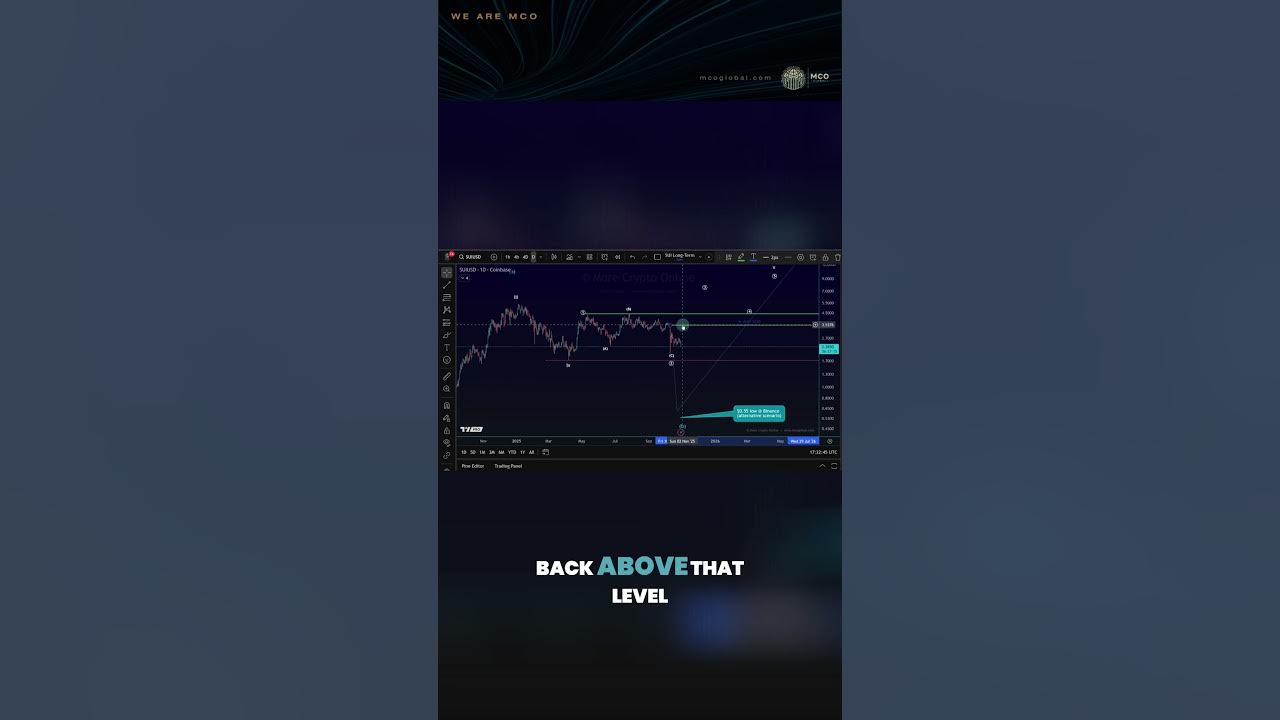
This technical analysis video examines SUI's price action and finds concerning signs despite a potential higher low on Coinbase. The analyst expresses skepticism about the current corrective upside movements, emphasizing the critical $3.50 resistance level that must be broken to confirm an uptrend. Chart discrepancies between Binance (bottoming at $0.55) and Coinbase ($2.00 wick) create analytical challenges. Key invalidation levels are identified at $1.70 and the previous low, with the analyst stating SUI "is still under pressure" until reclaiming $3.50. The video provides valuable guidance on navigating conflicting chart data and identifying valid reversal setups versus corrective bounces in downtrends.
Key Points
- [0:03] No Strong Reversal Pattern: The daily chart shows only corrective movements to the upside with no clear upside reversal pattern, indicating weakness in the current bounce attempt.
- [0:18] Chart Discrepancy Problem: Binance chart bottomed around $0.55 while Coinbase shows a higher low around $2.00, creating confusion about which level to use for technical analysis.
- [0:33] Critical $3.50 Resistance Level: The analyst emphasizes the need to break above $3.50 to finally get back into an uptrend, stating this is the key level for confirming bullish momentum.
- [0:51] Currently Under Pressure: SUI is explicitly stated to be "under pressure" as long as it remains below the $3.50 level, with current price action just a wave count tracking exercise.
- [1:21] $1.70 Breakdown Risk: If price breaks below the $2.00 wick on Coinbase chart, there's high likelihood of testing the $1.70 level, which would invalidate the current one-two setup.
- [2:14] Need for Local Low Evidence: Analyst requires either a local one-two setup from any swing low or a break above $3.50 to provide evidence that a bottom is in place.

Absolute Metrics
Relative Performance
Summary
This video provides critical technical analysis as Bitcoin tests major support levels around previous swing lows from June-October. The host identifies a key RSI trendline on the daily timeframe that has marked significant bottoms since June, noting Bitcoin is approaching oversold territory not seen since early 2025. With the 4-hour RSI already oversold below 30, the analyst outlines specific buying opportunities at daily RSI levels of 33-34 or if full oversold conditions materialize. The video addresses a crucial Elliott Wave question: whether Bitcoin is completing wave C of a correction or has begun a deeper A-wave decline, making this essential viewing for traders planning entries at potential major lows.
Key Points
- [0:00] Bitcoin Tests Critical Support Zone: Bitcoin has reached previous swing low levels from October, September, August, June, and July, establishing a significant support area
- [0:14] Daily RSI Approaching Key Trendline: Daily timeframe RSI is approaching the trendline that triggered upside reactions in June, August, and September 25th, aligned with major swing lows
- [0:46] Rare Oversold Opportunity Ahead: Breaking below the RSI trendline would create oversold conditions on the daily chart, a rare occurrence last seen in early 2025 during February-March buying opportunity
- [1:08] Specific Entry Strategy at RSI 33-34: Analyst plans to buy if oversold conditions materialize, with specific support watch level at daily RSI 33-34
- [1:19] 4-Hour RSI Already Oversold: The 4-hour timeframe has dropped below RSI 30 into oversold territory, historically preceding upside reactions or bullish divergences
- [1:33] Bullish Divergence Pattern Likely: Oversold 4-hour conditions often lead to another lower low creating bullish divergence, a frequent occurrence at this timeframe
- [1:54] Critical Elliott Wave Question: Market faces key decision point whether this is an extension of wave C of four or wave A of four correction
- [2:07] Two Scenario Analysis: Either one more low is coming in current structure or the B wave has already topped and C wave decline has begun

Absolute Metrics
Relative Performance
Summary
This video provides critical technical analysis for Solana traders facing potential downside risks. The analyst identifies key support levels at $172 (October 10th low), with deeper support zones at $150-$160 and $117-$138 if the breakdown continues. The analysis reveals a concerning three-wave structure rather than the bullish five-wave pattern needed for upside confirmation, indicating weakened momentum since October 10th. Traders should watch the $178 micro support level closely - a break below triggers potential ABC correction to $117. The video offers specific entry/exit levels and explains why current price action lacks bullish confirmation, making it essential viewing for position management.
Key Points
- [0:08] Critical Support Level at $172: October 10th low represents key support - breaking below opens door to $150-$160 zone
- [0:28] Deeper Support Targets Identified: Secondary support levels at $117.40-$138.20 align with previous structural swing lows and Fibonacci levels
- [1:07] ABC Correction Scenario Explained: Most likely bearish scenario shows wave A finished, currently in wave B, with C-wave down targeting $117 support
- [1:42] Broken Trust Since October 10th: Market hasn't shown strength since October 10th, breaking momentum and trader confidence
- [2:22] Three-Wave Structure Shows Weakness: Only three waves up detected in recent rallies, not the five-wave bullish pattern needed for confirmation
- [3:05] Micro Support at $178 Critical: Current support area at $178 based on wave 1 distance measurement - break below triggers further downside
- [3:34] Reversal Requirements Defined: Need micro five-wave move up plus break above previous swing high at $202 or ideally $212 (October 13th high) for bullish confirmation
- [4:06] No Bullish Signal Yet: Despite looking for bullish scenario, analyst sees no five-wave move up yet, keeping outlook cautious

Absolute Metrics
Relative Performance
Summary
This technical analysis reveals FET continues struggling below key resistance at 29 cents with mounting bearish pressure. The analyst identifies a completed five-wave downward structure, presenting two scenarios: a direct decline to 18.1 cents (100% extension target) or a potential B-wave bounce requiring a break above 27.5 cents to signal buyer activity. Critical support sits at 22.6 cents. The analysis warns of absent bull momentum and emphasizes the need for a micro one-two setup to confirm any recovery attempt. Investors should watch this for precise entry/exit levels and understand the structural weakness indicating further downside risk before any sustainable reversal.
Key Points
- [0:10] FET Holding Below First Resistance: Market continues to respect resistance levels in a bearish way, unable to push above the first pivot at 29 cents with downward pressure persisting in both yellow and white Elliott Wave scenarios.
- [0:31] No Evidence of Bottom Formation: Analyst states clearly there's no evidence that a low is in place yet, though a larger B-wave bounce remains possible in the yellow scenario requiring a turnaround signal.
- [1:02] White Scenario Takes Lead Without Reaction: If price doesn't show a reaction in current region, the more bearish white scenario will dominate, suggesting both wave counts show incomplete corrections ahead.
- [1:16] Five-Wave Decline Confirmed: Analyst spent significant time in recent days confirming a complete five-wave move down, forming wave A in the yellow scenario which sets up for ABC B-wave bounce structure.
- [1:44] Two Distinct Scenarios Diverge: White scenario suggests waves A and B already completed with direct C-wave decline forming, while yellow scenario anticipates upward B-wave first before final C-wave down.
- [2:10] Absence of Bull Activity Concerning: Analyst questions "where are the buyers?" noting lack of bull activity, stating that even a noticeable B-wave would signal buyers still exist in the market.
- [2:33] Key Breakout Level at 27.5 Cents: Move above 27.5 cents would signal yellow B-wave scenario is playing out and could send price into upper resistance area, serving as critical confirmation level.
- [2:50] 18.1 Cents Target Remains Active: 100% extension target at 18.1 cents discussed over recent days remains valid if B-wave already topped, representing same length as wave A in typical weak bounce pattern.
- [3:19] Micro One-Two Setup Required: Clear bullish reversal needs micro one-two setup to the upside to signal larger recovery is underway, providing specific structure traders should watch for.

Absolute Metrics
Relative Performance
Summary
This video provides critical technical analysis for XRP traders as the price breaks below key support at $2.50, invalidating the bullish impulse wave count. The analyst shifts focus to the bearish yellow scenario after XRP broke below the 50% retracement level, demonstrating strong resistance overhead. With clear price targets identified at $2.17-$2.25 for further downside, traders gain actionable support levels for position management. The analysis emphasizes the importance of pivot points in distinguishing between bullish and bearish scenarios, offering a disciplined framework for navigating XRP's current consolidation phase before any potential breakout attempt.
Key Points
- [0:00] XRP Breaks Below Micro Support: XRP has broken below the upper micro support area, revealing the strength of the overhead resistance zone and shifting the technical outlook toward a more bearish scenario.
- [0:09] $2.50 Break Invalidates Bullish Count: The break below $2.50 and the 50% retracement level makes it impossible to clearly favor the white bullish impulse count, even though it remains technically valid until resistance breaks.
- [0:32] Yellow Bearish Scenario Takes Lead: With the 50% retracement broken, the yellow bearish scenario is now clearly taking the lead as the price fails to maintain an impulsive structure upward.
- [0:36] Importance of Dual Scenario Planning: The analyst emphasizes always considering both bullish and bearish scenarios with pivot points that help distinguish between the two outcomes for disciplined trading.
- [0:46] Downside Target: $2.17-$2.25: Any further downside pressure from current levels opens the door to a decline toward approximately $2.17 to $2.25, providing clear support targets for traders to monitor.

Absolute Metrics
Relative Performance
Summary
Bonk cryptocurrency faces downward pressure requiring a break above 1.19589 to return to uptrend status. The analyst presents an Elliott Wave analysis suggesting the market remains in wave two correction, with the current structure showing an A-B-C pattern where the B wave failed to break Fibonacci resistance or reach the October 10th high. The video identifies the market as likely moving down in wave three of C, testing the October 17th low with expectations of further downside before completing waves four and five. Short-term momentum remains bearish until price breaks above the October 29th high at 15190.
Key Points
- [0:05] Critical Resistance Level: Bonk needs to break above 1.19589 to return to uptrend, otherwise market remains uncertain and rangebound with continued downward pressure
- [0:36] Wave Two Correction Thesis: Elliott Wave analysis suggests Bonk is still in wave two correction pattern, though thesis is not very strong due to unclear data from October 10th low
- [0:53] Failed B Wave Rally: The B wave rally got rejected at resistance and couldn't break above Fibonacci resistance or reach the October 10th high, indicating weakness
- [1:04] Wave Three of C Decline: Multiple chart analysis suggests Bonk is likely moving down in wave three of C, explaining the current downward pressure across the market
- [1:27] Testing October 17th Low: Price is currently testing the October 17th low support level, with expectations of moving lower in wave three before potential wave four bounce
- [1:42] Short-Term Bearish Outlook: Pressure remains downward in very short term, requiring at minimum a break above October 29th high at 15190 to shift momentum

Absolute Metrics
Relative Performance
Summary
This video provides critical Elliott Wave technical analysis for Bonk cryptocurrency traders facing current market pressure. The analyst identifies Bonk as range-bound and uncertain, requiring a break above 1.19589 to resume uptrend momentum. Key actionable insight: the current Wave 2 correction hasn't bottomed yet, with the market likely in Wave 3 of C downward movement. Specific price levels include testing the October 17th low, with downward pressure expected to continue through additional Wave 4 and 5 formations before a potential bottom forms. Short-term resistance sits at 1.15190 (October 29th high).
Key Points
- [0:00] Chart Analysis Setup: Analyst reviews 4-hour Bonk chart showing pressure similar to many other cryptos, establishing need for break above 1.19589 green line to return to uptrend
- [0:16] Market Status Classification: Market currently classified as uncertain and range-bound until key resistance level breaks, cautioning about Fibonacci measurement uncertainty across different chart lows
- [0:39] Wave 2 Correction Ongoing: Elliott Wave analysis indicates Wave 2 correction hasn't bottomed yet, with current thesis showing Wave 1 complete and A-wave down, B-wave up pattern identified
- [0:56] Resistance Rejection Analysis: B-wave was rejected at resistance level, failing to break above Fibonacci resistance or reach October 10th high, confirming downward bias
- [1:08] Wave 3 of C Movement: Current market likely moving down in Wave 3 of C, explaining sustained downward pressure and testing of October 17th low support level
- [1:34] Future Wave Structure Projection: Analysis projects further downside needed in Wave 3, followed by Wave 4 and Wave 5 formations before potential bottom can form
- [1:46] Short-term Resistance Level: Very short-term upside would require break above October 29th Wednesday high at 1.15190, confirming downward pressure remains dominant for now

Absolute Metrics
Relative Performance
Summary
Sergey Nazarov presents a realistic vision of cryptocurrency's mainstream adoption trajectory. Rather than expecting complete portfolio reallocation to Bitcoin, he outlines how crypto achieving 5% portfolio allocation across institutional and retail investors would drive Bitcoin to $1 million per coin. More importantly, he reveals the industry's next growth phase: tokenization of traditional assets. This shift means real estate, stocks, gold, and other mainstream assets will exist on blockchain infrastructure while Bitcoin and crypto maintain a meaningful but measured portfolio position. This dual-path adoption model—crypto as allocation plus traditional asset tokenization—represents the realistic roadmap for blockchain's integration into global finance.
Key Points
- [0:00] Realistic Adoption Model: Nazarov challenges the unrealistic expectation that mainstream adoption means everyone selling all real estate, gold, and stocks to buy only Bitcoin, arguing this 100% portfolio allocation scenario won't happen.
- [0:14] 5% Portfolio Allocation Target: He identifies the realistic path as cryptocurrency growing from sub-1% to 5% of investor portfolios across asset managers, sovereign wealth funds, and retail investors.
- [0:20] Million Dollar Bitcoin Math: The 5% portfolio allocation level across mainstream finance would mathematically drive Bitcoin to $1 million per coin, providing a concrete price target based on adoption metrics.
- [0:28] Tokenization as Next Growth Phase: Beyond crypto allocation, the industry's next major stage involves tokenizing all other portfolio assets—real estate, stocks, gold—onto blockchain infrastructure.
- [0:37] Industry Growth Direction: Nazarov emphasizes that tokenization of traditional assets represents what the blockchain industry is actively driving toward as its primary growth catalyst.

Absolute Metrics
Relative Performance
Summary
FET (Fetch.ai) remains under bearish pressure, failing to break above the 29-cent resistance level with continued downside momentum. The technical analysis identifies two scenarios: a yellow count suggesting a potential larger B-wave bounce if support holds in the current region, and a white count indicating further decline. Both scenarios agree the correction is incomplete, with no evidence of a bottom forming yet. Investors should watch for a turnaround signal and break above lower resistance to confirm the bounce scenario, otherwise further downside toward key support levels appears likely.
Key Points
- [0:02] Resistance Level Rejection: FET continues holding below first resistance at 29 cents, with levels being respected in a bearish manner as the market fails to push above this key pivot point.
- [0:16] Downward Pressure Confirmed: Pressure remains downward in both technical scenarios analyzed, with further downside appearing likely given the lack of evidence that a low is in place.
- [0:30] Yellow Scenario B-Wave Possibility: A larger bounce remains possible in the yellow scenario through a B-wave formation, but requires seeing a turnaround and upside momentum in the current region.
- [0:42] Resistance Breakout Requirements: For the bounce scenario to activate, FET needs to break above lower resistance and then reach upper resistance within the potential B-wave structure.
- [0:51] Critical Support Region: The current region represents a critical decision point where a reaction is needed, otherwise the white scenario of continued decline will take the lead.
- [1:00] Incomplete Correction Analysis: Both technical counts indicate the overall correction pattern looks incomplete, suggesting more price action is needed before a sustainable bottom forms.

Absolute Metrics
Relative Performance
Summary
This video provides critical technical analysis for Chainlink (LINK) traders focused on identifying the current correction pattern and key support levels. The analyst identifies a potential C-wave downside movement within a larger complex correction that began August 22nd, with a completed triangle pattern in the X-wave now breaking downward. The analysis examines whether the current structure represents a Z-wave ABC correction, offering traders specific pattern recognition insights to anticipate further downside movement and identify optimal entry points for the next bullish leg.
Key Points
- [0:07] Blue Scenario C-Wave Tracking: Analyst is tracking a potential C-wave to the downside in the blue scenario on Chainlink's short-term chart, suggesting the current correction may extend lower than initially anticipated.
- [0:23] Triangle Pattern in Wave X: A full triangle pattern has formed in wave X which could break out to the downside, though momentum was initially weak in recent days.
- [0:34] Downside Momentum Confirmed: The start of downside momentum has now been confirmed, validating the bearish triangle breakout scenario.
- [0:56] X-Wave Completion Structure: The X-wave appears to have completed with an A-wave down in three waves, followed by a B-wave up, and now entering a C-wave downward movement.
- [1:04] Z-Wave ABC Structure Analysis: The analyst identifies this as possibly a C-wave of Z, where the Z-wave follows an ABC structure based on a complex correction pattern.
- [1:13] Correction Origin Timeline: The complex correction being analyzed originated around August 22nd, providing context for the current downside movement and potential support levels.
Market Topics & Analysis
AI-aggregated insights from today's crypto content
Bitcoin Critical Support Levels $99K-$108K - Comprehensive Aggregation
Overview Multiple analysts have identified a critical support zone for Bitcoin between $99K-$108K, with consensus that breakdown below these levels could trigger deeper corrections to the $93-95K range or lower. This zone represents a confluence of technical indicators, moving averages, and historical support levels that have held throughout the current cycle.
Critical Support Levels Identified
Primary Support Zone: $107K-$108K EC Krown identifies $108,100 as a critical immediate support level, noting it was already tested during early morning hours [EC Krown @ TF7-7kYPHfY @ 01:13]. The average loss for Thursday historically would place Bitcoin around this level, which has already seen one bounce attempt [EC Krown @ TF7-7kYPHfY @ 01:15]. Coin Bureau Trading emphasizes that if the $107-108K level gives up, "it is a pretty much straight path to nowhere" [Coin Bureau Trading @ uMa_0_YsaYI @ 06:46]. More Crypto Online confirms this zone as structural support between approximately $104,200 and current prices [More Crypto Online @ QvQGnogJB1I @ 05:23].
Secondary Support: $102K-$103K Range EC Krown's 4-day CME setup targets approximately $102,700 at the green 55 EMA, which he states has been reached "every time in the past 8 years without any sort of major rally in between" when this cross-under occurs [EC Krown @ TF7-7kYPHfY @ 05:06]. The HPDR (High Profile Daily Range) bottom boundary aligns with $103,500, which "does align with one of our setups from the 4-day CME setup" [EC Krown @ TF7-7kYPHfY @ 15:09].
Major Support Zone: $99K-$100K There is strong consensus across multiple analysts that $99K represents a critical support level:
• EC Krown identifies $99,000 as the target for weekly timeframe setups, with the green 55 EMA positioned around this level [EC Krown @ TF7-7kYPHfY @ 07:36] • Jason Pizzino notes that the longer-term 50% level sits at $100K, "very close to your 50-week moving average as well" at around $103,000 [Jason Pizzino @ 9UmtFl52Eo8 @ 02:08] • More Crypto Online specifically identifies the 55-week exponential moving average at $99K as a key support [More Crypto Online @ QvQGnogJB1I @ 05:00] • Coin Bureau Trading mentions looking at levels at $100K, $99.4K, and $98.8K if dumping continues [Coin Bureau Trading @ uMa_0_YsaYI @ 09:28]
Technical Indicators Confirming Weakness
Moving Average Crosses Signaling Downside EC Krown presents extensive evidence of bearish moving average setups across multiple timeframes:
• 4-day CME: Red 4 EMA crossed under yellow 21 EMA approximately a week ago, historically signaling "minimum correction down to that green moving average" at $102,700 [EC Krown @ TF7-7kYPHfY @ 04:41] • 5-day timeframe: Target significantly lower at approximately $99,000, with EC Krown noting "one timeframe bleeds into the next" [EC Krown @ TF7-7kYPHfY @ 07:00] • Weekly timeframe: Also confirming cross with target around $99,000 [EC Krown @ TF7-7kYPHfY @ 07:32] • 2-day setup: Yellow 21 EMA vs green 55 EMA cross signals targets around $99,000 at the purple 200 EMA [EC Krown @ TF7-7kYPHfY @ 08:10]
RSI and Momentum Indicators EC Krown identifies hidden bearish divergence on the daily timeframe combined with a lower high compared to October 12th [EC Krown @ TF7-7kYPHfY @ 03:05]. More Crypto Online notes the daily RSI is "approaching this trend line again from where the market started upside reactions" with support expected around 33-34 on the daily RSI [More Crypto Online @ QvQGnogJB1I @ 00:23]. The 4-hour timeframe is "already oversold below 30" which historically precedes upside reactions, though sometimes with bullish divergences forming at lower lows [More Crypto Online @ QvQGnogJB1I @ 01:27].
Stochastic Momentum Warnings EC Krown provides detailed stochastic analysis showing corrective bias across higher timeframes: • Daily: Lower high at 106,650 crawling toward bearish control zone [EC Krown @ TF7-7kYPHfY @ 09:42] • 2-day: Pivot at 106,700 - closing below indicates bearish control zone dominance [EC Krown @ TF7-7kYPHfY @ 10:03] • Weekly: Below $115K signals continued downside [EC Krown @ TF7-7kYPHfY @ 10:33] • Monthly: "Really big deal" - momentum turning down for first time since June 2024 as long as Bitcoin stays below $116K [EC Krown @ TF7-7kYPHfY @ 11:00] • Bi-monthly: "Very concerning" - first cross down since July 2021 if closing below $113,350, with prior occurrences in November 2017 and January 2014 all marking cycle peaks [EC Krown @ TF7-7kYPHfY @ 11:46]
Breakdown Scenarios and Deeper Targets
$93K-$95K Range If the $99K-$100K zone fails, analysts identify the next major support cluster:
Jason Pizzino calculates that a 31-33% correction from the highs (consistent with prior cycle corrections) would place Bitcoin at $84,000-$86,000, bringing it "right back to the breakout point after the tariff low" [Jason Pizzino @ 9UmtFl52Eo8 @ 09:37]. He also identifies the breakout zone from high $80s to low $90s as a potential retest target if $100K breaks [Jason Pizzino @ 9UmtFl52Eo8 @ 02:56].
$70K-$74K Zone For more severe corrections, Jason Pizzino identifies the 50% level of the entire cycle range at $71K-$74K, which "also lines up with all of the previous tops from March" [Jason Pizzino @ 9UmtFl52Eo8 @ 03:09]. He notes this represents a 44% correction from the highs [Jason Pizzino @ 9UmtFl52Eo8 @ 10:10].
Market Context and Catalysts
Federal Reserve Policy Impact Coin Bureau Trading reports that the Fed cut rates by 25 basis points to the 3.75-4% range, but Jay Powell made clear that "December cut is not guaranteed" and policy is "not running on autopilot" [Coin Bureau Trading @ uMa_0_YsaYI @ 01:17]. Additionally, the Bank of Japan kept rates at 0.5% but hinted at potential hikes if wages pick up, which "immediately had an impact on the yen" and is causing the dollar to explode [Coin Bureau Trading @ uMa_0_YsaYI @ 01:47].
Trade War Developments Stacker Satoshi reports that Trump met with President Xi, which "helped soften the trade war fears" [Stacker Satoshi @ ge4pIgu2oFs @ 00:32]. Trump reduced China fentanyl tariffs from 20% to 10%, and China agreed not to impose rare earth controls [Stacker Satoshi @ ge4pIgu2oFs @ 07:42]. However, the initial market reaction was negative as there was "no joint press conference" and "no announcement" immediately following the meeting [Stacker Satoshi @ ge4pIgu2oFs @ 07:33].
Volume and Sentiment Indicators Jason Pizzino identifies concerning volume patterns: "anytime the price has come down the volume has increased" while moves to the upside show lower volume, indicating "more people willing to sell, less people willing to buy" [Jason Pizzino @ 9UmtFl52Eo8 @ 03:50]. He also notes Bitcoin has essentially gone nowhere in 317 days since the December top, which "naturally destroys the belief in what is coming next" through repeated cycles between extreme greed and extreme fear [Jason Pizzino @ 9UmtFl52Eo8 @ 00:09].
Current Price Action Assessment
Rejection from Key Resistance Multiple sources confirm Bitcoin failed to break above critical resistance: • Jason Pizzino: Failed to close above $115K (50% level from all-time high to October low) [Jason Pizzino @ 9UmtFl52Eo8 @ 01:11] • EC Krown: Rejection at $116K on a lower high was "significant" and "very likely going to cancel out any sort of short-term upside setups" [EC Krown @ TF7-7kYPHfY @ 05:17] • Coin Bureau Trading: Couldn't hold $112K zone, which was "very important" [Coin Bureau Trading @ uMa_0_YsaYI @ 07:17]
Immediate Trading Levels Coin Bureau Trading identifies a stairstepping pattern needed for recovery: closes above $111K (shortest term 50%), then $115K, $116K, and finally $120K representing "a lot of work to do here" [Coin Bureau Trading @ uMa_0_YsaYI @ 05:41]. The monthly timeframe is "looking very much red" down 4.8% with 24 hours to go, and unless Bitcoin can close above $115K, further downside is expected [Coin Bureau Trading @ uMa_0_YsaYI @ 06:00].
Consensus vs Divergent Views
Strong Consensus Points 1. Critical support zone exists between $99K-$108K - All analysts agree this range is pivotal 2. Breakdown risk is elevated - Multiple technical indicators across timeframes signal vulnerability 3. Next major support at $99K - The 55-week EMA represents a key demand zone 4. Failed resistance at $115K-$116K - Confirmed by all sources as a bearish signal
Divergent Perspectives Stacker Satoshi maintains a more bullish medium-term outlook, stating "I am still confident that we're going to see higher prices and that 2026 we are going to have some nice pumps" [Stacker Satoshi @ ge4pIgu2oFs @ 02:51]. He views current weakness as an opportunity, noting "when the markets are boring, that is when you need to pay attention because that is when people are selling the boredom" [Stacker Satoshi @ ge4pIgu2oFs @ 02:36].
EC Krown presents the most bearish near-term outlook, stating "I do think that there is potential that you know top is in for like a very very very long time" while personally remaining "just unwilling to say that highs are in forever" [EC Krown @ TF7-7kYPHfY @ 11:27]. He emphasizes the historical significance of the bi-monthly stochastic cross, showing it occurred at major cycle peaks in 2014, 2017, and 2021 [EC Krown @ TF7-7kYPHfY @ 12:18].
Jason Pizzino takes a cautious stance, noting he hasn't seen "the extreme move to the upside, that extreme blowoff top" which suggests "it's not the worst case" scenario [Jason Pizzino @ 9UmtFl52Eo8 @ 02:46]. However, he warns "there are a lot more signs leaning to the bearish now, at least in the short term" [Jason Pizzino @ 9UmtFl52Eo8 @ 21:00].
Trading Implications
For Bulls More Crypto Online suggests waiting for oversold conditions on the daily RSI (breaking below the trend line support around 33-34) as a potential buying opportunity, noting "I often buy when this happens" [More Crypto Online @ xkjpbn86KD8 @ 01:01]. Coin Bureau Trading maintains a bullish weekly bias despite current weakness, emphasizing the importance of "sticking to your rules regardless of what's happening" [Coin Bureau Trading @ uMa_0_YsaYI @ 09:05].
For Bears EC Krown identifies resistance between $110,460 and $114,372 for any corrective bounces [TF7-7kYPHfY @ implied from context]. He warns that "second pass almost always a scalable bounce, not so much" after the initial $108K test [EC Krown @ TF7-7kYPHfY @ 01:29].
Risk Management Jason Pizzino emphasizes having a clear plan: "knowing when you need to get out with your risk and reward. What's the risk to the downside? What's the reward left to the upside?" [Jason Pizzino @ 9UmtFl52Eo8 @ 28:40]. He notes that "a little loss is better than a large loss" if the market is starting to decline [Jason Pizzino @ 9UmtFl52Eo8 @ 29:02].
Historical Context
EC Krown provides critical historical perspective on the bi-monthly stochastic momentum indicator, showing that the three previous times it crossed to the downside from elevated levels were: • November 2017 - near the cycle top [EC Krown @ TF7-7kYPHfY @ 12:16] • January 2014 - near the cycle top [EC Krown @ TF7-7kYPHfY @ 12:19] • July 2021 - near the cycle top [EC Krown @ TF7-7kYPHfY @ 12:12]
He emphasizes: "These are not good signals" while maintaining some personal optimism for sideways-to-down action followed by a potential higher low in the mid-to-upper $90Ks [EC Krown @ TF7-7kYPHfY @ 12:50].
Conclusion
The $99K-$108K zone represents a critical inflection point for Bitcoin, with multiple technical indicators, moving averages, and historical support levels converging in this range. Consensus exists that breakdown below $99K would open the door to deeper corrections potentially reaching $93K-$95K or even lower targets around $84K-$86K. However, oversold conditions on shorter timeframes and the proximity to the 55-week EMA at $99K suggest this zone could provide significant buying interest. The immediate catalyst watch includes Fed policy decisions in December, ongoing trade negotiations between the US and China, and whether Bitcoin can reclaim resistance levels above $115K to invalidate the bearish setups currently in play.
Ethereum Technical Weakness Below $4,100 - Comprehensive Aggregation
Overview Ethereum faces significant technical challenges after failing to maintain support above $4,100, with multiple analysts identifying critical Fibonacci support zones and weakening trend lines that could determine the asset's near-term trajectory.
Key Technical Breakdown
Failed $4,100 Weekly Support Ethereum's rejection at weekly resistance and subsequent failure to hold $4,100 represents a critical technical breakdown. According to Coin Bureau Trading, "weekly support didn't hold at 4,100. So, we dumped from it" [Coin Bureau Trading @ uMa_0_YsaYI @ 10:56]. The analyst expressed extreme concern about this failure, noting "we're trading below the Vshape retest and then the week retest. Well, it's like final line of support" [Coin Bureau Trading @ uMa_0_YsaYI @ 11:01].
This breakdown is particularly significant because it occurred at a well-established weekly resistance level created "back beginning of September" [Coin Bureau Trading @ uMa_0_YsaYI @ 10:08], demonstrating the strength of overhead selling pressure.
Critical Fibonacci Support Zone Under Pressure More Crypto Online identifies a crucial Fibonacci support zone between $3,633-$3,861, stating "the support zone that we talked about in the previous video remains relevant. 3,633 to 3,861. That's our fib support zone here between the 78.6 retracement and the 50% retracement" [More Crypto Online @ pK_APKejD0A @ 00:21].
The analyst warns that "if we break below 3,633, it becomes more probable that this wave four is indeed unfolding still" [More Crypto Online @ pK_APKejD0A @ 02:14], indicating that a breakdown below this zone would confirm continued corrective price action rather than bullish reversal.
Lack of Bullish Reversal Signals
No Five-Wave Structure Confirmation More Crypto Online emphasizes the absence of critical Elliott Wave patterns needed for bullish confirmation: "without a fivewave move up and a three-wave move down, there is no reversal signal. This is only if you you know, a set of green candles" [More Crypto Online @ pK_APKejD0A @ 01:09]. The analyst stresses that "we are far away from any bullish reversal signals. The earliest signal would be a break above $3,945 here, the last swing high" [More Crypto Online @ pK_APKejD0A @ 01:21].
The most meaningful signal would require breaking above $4,400, but "as you can see, we're far away from that at the moment" [More Crypto Online @ pK_APKejD0A @ 01:37].
Ranging Market Structure Paul Barron Network's Data Dash analysis characterizes the current market as "a range, okay? It's it remains a range. We're holding support levels" [Paul Barron Network @ DZMUo27Mqac @ 02:01], with Ethereum trading between established boundaries rather than showing clear directional momentum.
Weakened Trend Line Analysis
Multiple Touch Points Signal Vulnerability Gareth Soloway provides detailed trend line analysis, noting that Ethereum is "sitting on top of the trend line" but warns that "the more you hit a trend line the weaker it becomes" [Gareth Soloway @ nYcM6mPUsYg @ 10:30]. He counts the touches: "going back here 1 2 3 4 5 6 7 this would be the eighth hit" [Gareth Soloway @ nYcM6mPUsYg @ 12:00], concluding "this is weak enough where I personally would not go long on ETH here" [Gareth Soloway @ nYcM6mPUsYg @ 12:13].
Despite respecting the support "until proven otherwise" [Gareth Soloway @ nYcM6mPUsYg @ 14:12], Soloway acknowledges the trend line has been "weakened significantly to the point that if it keeps hammering eventually it's going to break" [Gareth Soloway @ nYcM6mPUsYg @ 11:49].
Downside Risk Levels
Immediate Support Breakdown Targets Coin Bureau Trading identifies the next support levels if current zones fail: "levels like 3,524 and 3364 and God knows what else" [Coin Bureau Trading @ uMa_0_YsaYI @ 11:08]. More Crypto Online specifies that the "most meaningful support level is here 3,374" [More Crypto Online @ pK_APKejD0A @ 02:06].
Data Dash from Paul Barron Network establishes a critical invalidation level: "where I'm wrong and where things change is if we start living below 3,300" [Paul Barron Network @ DZMUo27Mqac @ 15:48], noting this as the threshold that would shift his longer-term outlook.
Resistance Levels for Recovery
Double Top Formation Gareth Soloway identifies clear upside resistance: "We have a double top up here, just under 5,000. This would be your resistance level" [Gareth Soloway @ nYcM6mPUsYg @ 12:46]. This double top pattern creates significant overhead supply that would need to be absorbed for any sustained rally.
ETH BTC Pair Considerations Coin Bureau Trading notes that while "ETH BTC's looking was looking good. It still looks good. It's just choppy at an area of interest" [Coin Bureau Trading @ uMa_0_YsaYI @ 10:46], the relative strength against Bitcoin hasn't translated into absolute price strength, suggesting broader market weakness.
Market Context and Trading Considerations
Risk Management Approach Multiple analysts stress cautious positioning. Gareth Soloway explains: "if you did want to, I've given you guys the toolkit to say, okay, I'll buy here at, you know 3875 right here. And if it closes below at 3750 and confirms, let's say down to 3715, you stop out" [Gareth Soloway @ nYcM6mPUsYg @ 12:28], providing a tight risk management framework.
Data Dash maintains a longer-term bullish view "as long as we're holding above 3,300" [Paul Barron Network @ DZMUo27Mqac @ 15:46], targeting "$5,000 to $7,000 box" [Paul Barron Network @ DZMUo27Mqac @ 16:21] over the coming months, though acknowledging near-term weakness.
Macro Headwinds Impact The technical weakness occurs against challenging macro conditions, with Paul Barron Network noting Fed uncertainty and Chair Powell's hawkish stance contributing to risk asset pressure across the board [Paul Barron Network @ DZMUo27Mqac @ 01:37].
Consensus View
All four analysts agree that Ethereum faces significant technical challenges at current levels:
1. Support Failure: The $4,100 weekly support breakdown is confirmed and concerning 2. Critical Zone: The $3,633-$3,861 Fibonacci support zone represents the last major defense 3. Weakened Structure: Multiple touches of support trend lines have reduced their reliability 4. No Bullish Confirmation: Absence of five-wave Elliott Wave structures prevents confident bullish calls 5. Risk/Reward: Current positioning offers limited upside with substantial downside risk
The technical picture suggests Ethereum requires either a decisive hold above $3,630 with subsequent reclaim of $4,100+ levels, or acceptance of further downside toward $3,300-$3,374 before establishing a more reliable support base for recovery.
Bitcoin Cycle Top and Bearish Technical Signals
Consensus: Q4 2025 Cycle Top Around $116-126K
Multiple analysts agree that Bitcoin likely reached its cycle top in Q4 2025, with the peak occurring around $116,000-126,000 based on historical four-year cycle patterns. Into The Cryptoverse states: "I do firmly believe that the top for this market cycle is going to be the fourth quarter of this year...if you look at all prior cycle tops for Bitcoin, they occurred in the fourth quarter of the post election year or the post having year" [Into The Cryptoverse @ zJH5z1VhmEo @ 00:00]. EC Krown confirms this timing, noting "if you believe in the four-year cycle, October, early October should be your high...it was right on time. It made a slightly new ultimate 126" [EC Krown @ TF7-7kYPHfY @ 14:01].
Multi-Timeframe Bearish Divergences
Analysts have identified bearish divergences across multiple timeframes signaling potential trend reversal. EC Krown reports "hidden bearish divergence" on the daily timeframe with "a lower high compared to the last local high, which was the 12th of October" [EC Krown @ TF7-7kYPHfY @ 03:03]. The technical breakdown extends across higher timeframes: "5day time frame is going to continue to the downside...weekly time frame is going to continue to the downside as long as Bitcoin's below 115...10day time frame also going to continue to the downside from really critical levels here as long as Bitcoin's below 119" [EC Krown @ TF7-7kYPHfY @ 10:19].
Most significantly, the monthly and bimonthly momentum indicators are turning bearish for the first time since major cycle tops. EC Krown emphasizes: "monthly time frame is going to see the momentum turn to the downside for the first time since June of this year...as long as Bitcoin's below 116" [EC Krown @ TF7-7kYPHfY @ 11:07]. The two-month timeframe signal is particularly concerning: "the bimonthly time frame...very likely both going to turn down...the first cross to the downside since July of 2021. And the one before that was all the way over here in November of 2017. And the one before that was all the way over here in January of 2014" [EC Krown @ TF7-7kYPHfY @ 11:46]. All three previous instances occurred at or near major cycle tops.
Moving Average Death Crosses Across Timeframes
Multiple moving average crossovers are confirming downside targets. EC Krown identifies a critical 4-day setup on CME: "red moving average crossing to the underside of the yellow moving average. That's a 4 EMA versus the 21 EMA. And anytime that we've seen that cross under on a closing basis, there has been a minimum correction down to that green moving average" at approximately $102,700 [EC Krown @ TF7-7kYPHfY @ 04:21]. The 5-day timeframe shows a similar pattern with targets around $99,000, and the weekly timeframe confirms the same cross with matching targets [EC Krown @ TF7-7kYPHfY @ 07:00].
Jason Pizzino notes Bitcoin is "basically at 108,000, where it was at the December top 317 days ago. So in essence, the price has essentially gone nowhere in this time" [Jason Pizzino @ 9UmtFl52Eo8 @ 00:00], creating a prolonged consolidation that has "destroyed sentiment throughout the last stage of this cycle."
Volume Profile Shows Distribution
Volume analysis reveals sellers dominating recent price action. Jason Pizzino observes: "the down moves anytime the price has come down the volume has increased...higher than the moves to the upside. So look at these moves to the up in the green here...the volume begins to increase compared to where it was when the market was going up. So in essence, you've got more people willing to sell, less people willing to buy" [Jason Pizzino @ 9UmtFl52Eo8 @ 03:50]. He describes the recent interest rate cut bounce as a "news failure" where despite positive catalysts, "the market has continued to fall" [Jason Pizzino @ 9UmtFl52Eo8 @ 04:36].
Key Support Levels and Downside Targets
Analysts identify critical support zones based on Fibonacci retracements and historical levels. Jason Pizzino establishes key levels: "we need to see closes above 115 and then above 120...Otherwise, the Bitcoin price is at risk breaking 103, testing 100, which is the longer term 50% level" [Jason Pizzino @ 9UmtFl52Eo8 @ 01:47]. Breaking below $100K increases the probability of testing "this breakout zone of the high 80s to low 90s and then back to the 50% level which is around 70 to $74,000" [Jason Pizzino @ 9UmtFl52Eo8 @ 02:56].
EC Krown provides similar targets through moving average analysis, with the 5-day and weekly setups pointing to $99,000 as a minimum correction level [EC Krown @ TF7-7kYPHfY @ 07:36]. The 2-day timeframe setup adds confluence: "when the lower period, the 21, the yellow one crosses the underside of the green one, then that initiates a setup...it has perfectly gotten down at least to that purple moving average. That's going to be the 200 EMA...around 99,000 bucks" [EC Krown @ TF7-7kYPHfY @ 08:10].
Historical Pattern Comparisons
Into The Cryptoverse draws parallels to the 2019 cycle where "Bitcoin topped out before quantitative tightening ended" [Into The Cryptoverse @ PvDskt21bnI @ 09:02]. With the Fed announcing QT will end December 1st, the pattern suggests potential for further downside: "if it plays out like 2019, maybe that ends up being a local top" [Into The Cryptoverse @ PvDskt21bnI @ 13:13]. However, they note a key difference: "last cycle rate cuts signal the top...they didn't this time" [Into The Cryptoverse @ PvDskt21bnI @ 14:08], suggesting not all historical patterns must repeat exactly.
Jason Pizzino highlights the "three-day signal" from the all-time high: "red, red, red, lower highs, lower lows. Not an up day, like not a green close. It's just lower highs, lower lows. Basically, sellers taking control and giving you a very early warning sign that the trend may be changing" [Jason Pizzino @ 9UmtFl52Eo8 @ 13:31]. This pattern has preceded major corrections at 33% in March 2025 and 30% in December 2024 [Jason Pizzino @ 9UmtFl52Eo8 @ 13:19].
Divergence: Missing Euphoria Argument
A key divergent view suggests the cycle may not be complete due to lack of extreme sentiment. Into The Cryptoverse notes: "this cycle, we have not really seen euphoria in the way that we saw in the fourth quarter of 2013 and the fourth quarter of 2017 and the fourth quarter of 2021" [Into The Cryptoverse @ PvDskt21bnI @ 12:21]. Jason Pizzino confirms this observation: "we haven't seen Bitcoin blow up into this top...get into euphoria or this thrill, maybe some optimism and belief" [Jason Pizzino @ 9UmtFl52Eo8 @ 06:38]. He describes it as a "reverse bull market where earlier on we saw" extreme greed, "but as one comment yesterday put it...this looks like a reverse bull market" [Jason Pizzino @ 9UmtFl52Eo8 @ 06:52].
This missing euphoria provides a counterargument that the cycle could extend into December or early 2026. Into The Cryptoverse suggests: "If Bitcoin is not able to move higher by December, then it's probably not going to for a while" [Into The Cryptoverse @ PvDskt21bnI @ 26:22], but leaves open the possibility of "altcoins liquidity is likely going to go back to Bitcoin. And if that's true, then maybe Bitcoin could go higher one final time before the cycle's over" [Into The Cryptoverse @ PvDskt21bnI @ 29:03].
Market Structure and Relative Performance
Bitcoin's underperformance against traditional assets signals cycle maturation. Jason Pizzino shows Bitcoin/gold ratio "declining for many months and is below the March top. When this has happened, it's generally signaled the end of the cycle" [Jason Pizzino @ 9UmtFl52Eo8 @ 11:50]. Similar weakness appears against silver, NASDAQ, and S&P 500 [Jason Pizzino @ 9UmtFl52Eo8 @ 12:32].
EC Krown expresses strong conviction about the bearish setup: "I do think that there is potential that you know top is in for like a very long time...I'm just unwilling to say that, hey, you know, highs are in for forever. I'm just downside angled for now. All bounces are, you know, are just that bounces until proven otherwise" [EC Krown @ TF7-7kYPHfY @ 11:23].
Expected Decline Magnitude
If the cycle top is confirmed, analysts expect corrections ranging from 31-44% based on historical patterns. Jason Pizzino calculates: "if we do that from the highs, 31 is 86,000. 33 is about an 84,000" bringing price back to the post-tariff breakout level [Jason Pizzino @ 9UmtFl52Eo8 @ 09:30]. Deeper corrections to "44% down to the $71,000 level, which is the 50% line...the cycle 50%" align with all previous resistance levels before the breakout [Jason Pizzino @ 9UmtFl52Eo8 @ 10:10].
Into The Cryptoverse provides a more optimistic scenario: "if the top is in, then you you you might not have nearly as massive of a drop as in prior cycles. You might have more of like what you saw in 2019 where the price just hovered above 10k for a while" [Into The Cryptoverse @ PvDskt21bnI @ 13:38], suggesting Bitcoin could consolidate around $100K similar to how it consolidated around $10K in 2019.
Critical Confirmation Levels
For bullish invalidation, analysts agree on specific price levels. Jason Pizzino states: "we need to see at the very least closes above 111...And right through that middle is your 111 level...It's going to be a stairstepping move to the upside. 111 115 116 those tops and then of course 120" [Jason Pizzino @ 9UmtFl52Eo8 @ 05:30]. EC Krown adds that monthly momentum turning bearish requires Bitcoin staying "below 116" [EC Krown @ TF7-7kYPHfY @ 11:14].
Into The Cryptoverse provides the long-term bear confirmation: "I will start to adopt a macro high in if and when Bitcoin does come back down below those April lows" around $74K [EC Krown @ TF7-7kYPHfY @ 13:31], which would definitively mark the end of the bull cycle.
Timeline and Probability Assessment
The consensus view assigns high probability (60%+) to the October 2025 high being the cycle top, with December 2025 as the final deadline for bullish continuation. Into The Cryptoverse states: "I'd say there's like at least a 40% chance that the top of the cycle is in October" [Into The Cryptoverse @ PvDskt21bnI @ 14:57], implying 60%+ conviction. They add: "if by December Bitcoin is still not at all-time highs, then it's likely not going to be. But if we go to new all-time highs and we go to 130 140, there's a good chance we're flirting with the market cycle top" [Into The Cryptoverse @ PvDskt21bnI @ 30:22].
EC Krown's bimonthly momentum indicator closing October 31st represents a critical juncture: "barring a $8,000 rally from where things are at kind of right now...we're going to see that turn down in the critical zone on bearish divergence" [EC Krown @ TF7-7kYPHfY @ 11:14], which would mark the first such signal since July 2021—just before that cycle's bear market began.
AI-Driven Corporate Layoffs Accelerating
Executive Summary Companies are dramatically increasing AI spending while simultaneously cutting jobs to afford these investments, creating a "nightmare scenario" for middle-class workers. This trend is being driven by intense board pressure to demonstrate AI profitability, even as the technology has yet to deliver promised cost savings.
Key Findings
Executive Pressure Driving AI Investment A staggering 78% of executives report being under intense pressure from boards and investors to prove AI is saving money and boosting profits [Steven Van Metre @ h96KVBzLINY @ 07:18]. However, multiple sources note that AI is not actually delivering these cost savings yet [Steven Van Metre @ h96KVBzLINY @ 07:24], forcing companies into a difficult position where they must cut costs elsewhere to fund continued AI investments.
Funding AI Through Workforce Reductions Companies are spending increasingly large amounts on AI infrastructure and are cutting jobs specifically to afford these investments [oclN14-n3mg @ 00:30, h96KVBzLINY @ 07:13]. This represents a fundamental shift in corporate strategy where AI spending takes priority over workforce retention. Firms are "quietly trimming headcount by not replacing vacated roles" [Steven Van Metre @ h96KVBzLINY @ 07:39], creating what economists describe as a "low hiring, low firing phase" where job losses occur through attrition rather than mass layoffs.
Scale of Job Displacement The impact is already substantial and accelerating. Recent layoffs include UPS eliminating 48,000 employees, Amazon cutting 33,000 positions, and Intel reducing headcount by 24,000 workers [Crypto Tips @ 0q-FLfzkn9w @ 06:06]. Amazon is separately increasing its robotics program by 75%, which is projected to replace over a million jobs [Crypto Tips @ 0q-FLfzkn9w @ 05:50]. Sources emphasize this is just "the tip of the iceberg" [Crypto Tips @ 0q-FLfzkn9w @ 06:03], suggesting significantly more job losses are coming as AI and robotics deployment accelerates.
Vulnerable Demographics The middle class faces a particularly dire situation, described as a "nightmare scenario" where companies are actively seeking to replace workers with AI [Steven Van Metre @ h96KVBzLINY @ 07:09]. Young workers in their late 20s and early 30s are especially challenged, already dealing with unemployment, student loan debt, and slower wage growth before AI displacement begins [Steven Van Metre @ h96KVBzLINY @ 02:47]. The economic stress is flowing upward from low-income to middle-income workers, creating broader consumer spending pullbacks [Steven Van Metre @ h96KVBzLINY @ 03:36].
Economic Multiplier Effects The layoffs are creating a vicious cycle where job losses reduce consumer spending power, leading to further economic contraction and additional layoffs. If holiday sales disappoint as expected, sources predict accelerated job cuts in 2026 across retail, manufacturing, wholesale, and transportation sectors [Steven Van Metre @ h96KVBzLINY @ 07:53]. This confluence of AI-driven job losses and weakening consumer demand represents a fundamental shift in labor market dynamics.
Consensus View All sources agree that AI-driven job displacement is real, accelerating, and will intensify as technology improves [Crypto Tips @ 0q-FLfzkn9w @ 06:34]. There is unanimous recognition that companies are prioritizing AI investments over workforce retention, with board-level pressure driving this strategic shift despite unclear ROI on AI spending.
Market Context Notably, while companies aggressively invest in AI infrastructure, the stock market shows Nvidia—a primary beneficiary of AI chip demand—reaching a $5 trillion market cap [Crypto Tips @ 0q-FLfzkn9w @ 06:38], indicating massive capital flows into AI despite the uncertain economic impact on workers and broader consumption patterns.
Consumer Spending Collapse and Recession Warning
Executive Summary
Major corporate CEOs are issuing stark warnings about consumer spending collapse as Americans run out of discretionary income. Chipotle's stock crashed 18% in pre-market trading after CEO Scott Boatright warned of "a massive pullback of our core audience" [Steven Van Metre @ h96KVBzLINY @ 01:08], while Kraft Heinz CEO stated bluntly: "We now have one of the worst consumer sentiments we have seen in decades as we go into the holiday season" [Euro Dollar University @ -dCtZc1piMU @ 01:03]. The crisis is hitting lower-income consumers hardest, with 40% of Chipotle's customers earning under $100,000 annually significantly cutting back on eating out [Steven Van Metre @ h96KVBzLINY @ 01:55].
Consumer Spending Collapse: Corporate Warnings
Chipotle's Dramatic Decline
Chipotle Mexican Grill experienced its worst single-day stock drop since 2012, falling 18% in pre-market trading and now down 34% year-to-date [Steven Van Metre @ h96KVBzLINY @ 01:08]. The company cut its full-year outlook for the third time this year as CEO Scott Boatright confirmed "the consumer slowdown is really affecting our business in a meaningful way" [Steven Van Metre @ h96KVBzLINY @ 01:28]. The CEO specifically noted "a massive pullback" of the company's core millennial and Gen Z audience [Euro Dollar University @ -dCtZc1piMU @ 00:42], who are "particularly challenged due to unemployment, student loan debt, and slower wage growth" [Steven Van Metre @ h96KVBzLINY @ 02:45].
The fast-casual chain reported that comparable store sales barely rose in Q3, falling short of Wall Street expectations [Euro Dollar University @ -dCtZc1piMU @ 05:56]. Guggenheim analyst Gregory Frankfort warned that "sales growth will likely remain pressured into next year with lower and lower middle income customers bulking at meal prices" [Steven Van Metre @ h96KVBzLINY @ 03:23].
Kraft Heinz Confirms Broader Crisis
Kraft Heinz echoed Chipotle's warnings with equally dire assessments. CEO stated: "We now have one of the worst consumer sentiments we have seen in decades as we go into the holiday season" [Euro Dollar University @ -dCtZc1piMU @ 01:03]. The food giant reported a 3.8% drop in North America net sales during Q3 [Euro Dollar University @ -dCtZc1piMU @ 09:00], with both sales and volumes falling as consumers resist price increases.
The CEO added that "the consumer negativity and the sentiment has extended longer than we had originally expected" [Euro Dollar University @ -dCtZc1piMU @ 08:51], acknowledging the company now focuses on making products "affordable" [Euro Dollar University @ -dCtZc1piMU @ 09:44] to maintain sales volumes.
Root Cause: Labor Market Deterioration
Wage Growth and Hours Worked Declining
All three sources identify weakening labor conditions as the fundamental driver of spending collapse. "The labor market is weakening, wage growth is slowing, hours worked are slumping" [Steven Van Metre @ oclN14-n3mg @ 00:14], creating an "economic nightmare" [Steven Van Metre @ oclN14-n3mg @ 00:21]. Data shows a strong correlation between declining average weekly hours for production and non-supervisory employees and falling retail sales [Steven Van Metre @ h96KVBzLINY @ 02:10].
Consumer sentiment data reveals expectations that "hours worked are going to fall even more in the months to come" [Steven Van Metre @ h96KVBzLINY @ 02:39]. The Federal Reserve's own Survey of Consumer Expectations showed job-finding expectations dropped to a record low of 44.9 in August—worse than the pandemic—and barely recovered to 45.2 in September [Euro Dollar University @ -dCtZc1piMU @ 14:06].
Unemployment and Income Stress
Younger consumers face particular hardship, with those "in their late 20s and early 30s particularly challenged due to unemployment, student loan debt, and slower wage growth" [Euro Dollar University @ -dCtZc1piMU @ 08:04]. The resumption of student loan repayments is forcing consumption cuts in real time [Steven Van Metre @ h96KVBzLINY @ 02:57]. About 40% of Chipotle's customers earn less than $100,000 annually, and "that income cohort has significantly cut back on eating out due to concerns about the economy and inflation" [Steven Van Metre @ h96KVBzLINY @ 01:55].
Spreading Beyond Low-Income Consumers
Crisis Moving Up Income Ladder
While lower-income consumers bore the initial impact, "financial stress from low-income workers is flowing right up to the middle class" [Steven Van Metre @ h96KVBzLINY @ 03:34]. Chipotle reported "a broad pullback in visit frequency across all income cohorts" [Euro Dollar University @ -dCtZc1piMU @ 07:41], not just those at the bottom. This validates warnings that economic weakness would spread beyond the lowest earners [Steven Van Metre @ h96KVBzLINY @ 03:38].
The consequence is rising delinquencies and the failure of subprime lenders as "consumers are simply running out of money. They can't afford to pay all their debts and they can't continue to maintain their discretionary spending. Something has to break" [Steven Van Metre @ h96KVBzLINY @ 03:44].
Holiday Season Outlook: Dismal
Conference Board Warning
The Conference Board reported that "preliminary data suggests that consumers' holiday spending will be down this season compared to last year" [Euro Dollar University @ -dCtZc1piMU @ 11:52]. Americans expect to spend 3.9% less on gifts and a shocking 12% less on non-gift items—in nominal terms, meaning even worse in real volume terms [Euro Dollar University @ -dCtZc1piMU @ 12:01].
When asked about spending decisions, "consumers most frequently cited promotions and getting the most out of every dollar" [Euro Dollar University @ -dCtZc1piMU @ 12:16], indicating severe budget constraints. Consumers also indicated they will "be likely buying fewer goods if the price of imported items is inflated by tariffs" [Euro Dollar University @ -dCtZc1piMU @ 12:24].
Retailers Refusing to Hire
Retailer behavior confirms pessimism about holiday sales. According to Challenger, Gray and Christmas, "the number of planned hires tracked by Challenger was just one quarter of what it had been at the same point last year"—a 75% decline [Euro Dollar University @ -dCtZc1piMU @ 13:00]. The refusal of retailers to commit to seasonal hiring announcements "showed everything you needed to know about how retailers are leaning as far as the all-important Christmas season is concerned" [Euro Dollar University @ -dCtZc1piMU @ 13:16].
Federal Reserve Response and Debate
Fed Uncertainty Despite Evidence
Fed Chair Jerome Powell did not commit to a December rate cut, stating some FOMC members question whether "there really are downside risks to the labor market or see whether in fact the stronger growth that we're seeing is real" [Euro Dollar University @ -dCtZc1piMU @ 02:21]. However, Powell acknowledged "job gains have slowed this year and the unemployment rate has edged up" [Steven Van Metre @ h96KVBzLINY @ 04:24].
Despite uncertainty, all FOMC members except Kansas City's Jeff Schmid voted for the latest rate cut [Euro Dollar University @ -dCtZc1piMU @ 07:21], suggesting even inflation-focused members recognize economic weakness even if they want more proof before committing to December action.
"Pringles Rule Interest Rates"
One source argues "the Pringles can is in charge of interest rates, not J. Powell" [Euro Dollar University @ -dCtZc1piMU @ 01:57], suggesting market forces—not Fed discretion—will ultimately dictate policy. Powell himself acknowledged: "If we do wind up resuming rate cuts, at some point we will" [Euro Dollar University @ -dCtZc1piMU @ 15:03], indicating rate cuts will continue as economic reality becomes undeniable.
AI-Driven Job Losses Accelerating Crisis
An additional factor compounding labor market weakness is companies slashing jobs to fund AI investments. "78% of executives said they're under intense pressure from boards and investors to prove AI is saving money and boosting profits" [Steven Van Metre @ h96KVBzLINY @ 07:17]. Companies are spending heavily on AI and "cutting spending where they can," which "would lead to job losses and now we're starting to see it" [Steven Van Metre @ h96KVBzLINY @ 07:26].
Economists describe the labor market as "stuck in a low hiring, low firing phase with firms quietly trimming headcount by not replacing vacated roles" [Steven Van Metre @ h96KVBzLINY @ 07:36]. If holiday sales disappoint as expected, "into next year we're going to see more job cuts" from retailers, manufacturers, wholesalers, and transportation sectors [Steven Van Metre @ h96KVBzLINY @ 07:53].
Political and Economic Implications
Dismissing Economic Reality Has Consequences
One source argues the disconnect between stock market highs and consumer reality fuels political radicalization. Younger generations have been told "their whole life this is a booming economy" while struggling economically, leading them to conclude "if this is the best that capitalism, free markets can provide, give me something else" [Euro Dollar University @ -dCtZc1piMU @ 03:52]. The message: "Stop saying the economy is booming and start getting to work fixing it" [Euro Dollar University @ -dCtZc1piMU @ 04:08].
Consensus: Recession Already Underway
All sources agree the U.S. is already in or entering recession. "The Fed here isn't trying to stop a recession. We're already likely in the midst of the beginning stages that's only going to get worse" [Steven Van Metre @ oclN14-n3mg @ 00:36]. The evidence from corporate earnings, consumer sentiment, holiday spending plans, and labor market data "tells exactly the same story" [Euro Dollar University @ -dCtZc1piMU @ 14:02] of an economy in serious trouble despite elevated stock prices.
Citations Summary • Chipotle warnings: [Steven Van Metre @ oclN14-n3mg @ 00:00], [Steven Van Metre @ h96KVBzLINY @ 01:08], [Euro Dollar University @ -dCtZc1piMU @ 00:36] • Kraft Heinz warnings: [Euro Dollar University @ -dCtZc1piMU @ 01:03], [Euro Dollar University @ -dCtZc1piMU @ 08:51] • Labor market weakness: [Steven Van Metre @ oclN14-n3mg @ 00:14], [Steven Van Metre @ h96KVBzLINY @ 02:10], [Euro Dollar University @ -dCtZc1piMU @ 14:06] • Holiday outlook: [Euro Dollar University @ -dCtZc1piMU @ 11:52], [Euro Dollar University @ -dCtZc1piMU @ 13:00] • Fed response: [Steven Van Metre @ h96KVBzLINY @ 04:24], [Euro Dollar University @ -dCtZc1piMU @ 02:21], [Euro Dollar University @ -dCtZc1piMU @ 15:03]
Chainlink Bearish Technical Structure
Overview Multiple analysts are tracking a completed triangle pattern breakdown in Chainlink, with the asset currently in a C-wave decline targeting key support levels between $15.70 and $13.30. The technical structure shows weakening momentum and lacks convincing bullish reversal signals.
Triangle Pattern Breakdown & Wave Structure
More Crypto Online identifies a completed triangle pattern in wave X that has broken down, initiating downside momentum [More Crypto Online @ yLbErq5o-as @ 00:25]. The analyst explains this is part of a complex correction that started on August 22nd, with the current move being a C-wave decline within a larger Z-wave ABC structure [More Crypto Online @ yLbErq5o-as @ 01:10]. The X-wave completion was followed by an A-wave down in three waves, a B-wave up, and now a C-wave decline is in progress [More Crypto Online @ yLbErq5o-as @ 00:56].
Lack of Bullish Reversal Signals
A critical concern highlighted is the absence of any convincing five-wave move to the upside throughout the downtrend [More Crypto Online @ yLbErq5o-as @ 01:20]. More Crypto Online notes that all movements to the upside have been corrective three-wave structures, including the recovery from the October 10th flash crash [More Crypto Online @ yLbErq5o-as @ 01:40]. This "back-to-back corrective price action leaves us without solid foundation for a proper upside reversal" [More Crypto Online @ yLbErq5o-as @ 01:50]. The analyst emphasizes that only a proper five-wave sequence to the upside would signal completion of the correction [More Crypto Online @ yLbErq5o-as @ 02:15].
Key Support & Resistance Levels
Immediate Resistance: Chainlink has failed to break above initial resistance around $19.18-$19.68, which must be cleared before considering higher prices [More Crypto Online @ yLbErq5o-as @ 02:25].
Support Levels (in order): • $16.86: Current 78.6% Fibonacci retracement of the last rally, already reached [More Crypto Online @ yLbErq5o-as @ 02:43] • $15.70: October 17th low, considered likely to be tested [More Crypto Online @ yLbErq5o-as @ 02:48] • $15.00: October 10th low [More Crypto Online @ yLbErq5o-as @ 02:53] • $13.30: Larger degree 78.6% Fibonacci retracement, representing the bullish boundary [More Crypto Online @ yLbErq5o-as @ 02:57]
More Crypto Online gives Chainlink "the room all the way down to $13.30" from a bullish perspective, but warns that below this level "it starts to get really tricky for the bulls" [More Crypto Online @ yLbErq5o-as @ 03:08].
Bearish Flag Pattern Confirmation
Gareth Soloway provides additional bearish confirmation through pattern recognition. He identifies a flag formation with "the crash was a flag pull down and then sideways inside bar" [Gareth Soloway @ nYcM6mPUsYg @ 15:11]. While the pattern is currently holding support, he warns that if it breaks, "this likely goes back to this low at around 15 bucks" [Gareth Soloway @ nYcM6mPUsYg @ 15:18].
Soloway targets even lower levels for potential long entries, identifying $13.75 as his preferred buying zone based on pivot tops forming a V-bottom and cup-and-handle pattern [Gareth Soloway @ nYcM6mPUsYg @ 15:27].
Consensus & Divergence
Consensus: Both analysts agree on: • Bearish technical structure with downside momentum • $15.00-$15.70 as next major support zone • $13.30-$13.75 as critical lower support levels • Lack of bullish confirmation signals
Minor Divergence: More Crypto Online focuses on Elliott Wave analysis and Fibonacci retracements, while Soloway emphasizes classical chart patterns (flags, cup-and-handle). However, their price targets align closely, with both identifying the $13.30-$13.75 zone as a critical decision point for bulls.
Current Assessment
Downward pressure remains dominant with Chainlink having reached the 78.6% retracement level. More Crypto Online concludes that "pressure remains downward" and the situation requires minimally a break above initial resistance ($19.18-$19.68) before considering higher prices [More Crypto Online @ yLbErq5o-as @ 02:40]. Until then, further downside toward the $15.70-$13.30 support zone appears probable.
Trump-Xi Meeting and China Tariff Reductions: Comprehensive Aggregation
Meeting Overview and Initial Reception
President Donald Trump and Chinese President Xi Jinping met in South Korea, with Trump characterizing the meeting as a "12 out of 10" [Trader Nick @ 8LII4sQ_X2Y @ 00:14]. Beijing also described the results as "hard won" [Trader Nick @ 8LII4sQ_X2Y @ 00:20]. However, the meeting concluded without a joint press conference or formal announcement [Stacker Satoshi @ ge4pIgu2oFs @ 07:27], initially causing market uncertainty.
Key Agreement Components
Tariff Reductions The most significant immediate outcome was the reduction of the "fentanyl tariff" on Chinese goods from 20% down to 10% [8LII4sQ_X2Y @ 00:25, ge4pIgu2oFs @ 08:06, BIY3g0zDjTY @ 04:22]. This represented a substantial easing of trade tensions between the two nations.
Trade Commitments In return for the tariff reduction, China agreed to several concessions: • Purchase of "massive amounts of soybeans" according to President Trump [8LII4sQ_X2Y @ 00:31, BIY3g0zDjTY @ 04:28] • Commitment to make it easier for the US to buy rare earths [8LII4sQ_X2Y @ 00:36, BIY3g0zDjTY @ 04:31] • China stated it would not impose rare earth controls [Stacker Satoshi @ ge4pIgu2oFs @ 08:50]
US Concessions The United States agreed to suspend an expansion of export controls on foreign firms listed on the entity list, which had been targeting Chinese companies [8LII4sQ_X2Y @ 00:40, BIY3g0zDjTY @ 04:35].
Deal Status: Incomplete but Promising
Multiple sources emphasized a crucial caveat: while progress was made, no comprehensive trade deal was actually signed. Trump indicated that a US-China trade deal "could be signed pretty soon, but there's no ink on the paper just yet" [DZMUo27Mqac @ 04:41, 8LII4sQ_X2Y @ 00:49]. This lack of a finalized agreement was described as "the crucial part" of the situation [Trader Nick @ 8LII4sQ_X2Y @ 00:54].
Market Reaction and Analysis
Initial Volatility The market response was mixed and volatile. Following the meeting with no immediate press conference, markets initially dumped [Stacker Satoshi @ ge4pIgu2oFs @ 00:05]. One analyst noted "the markets have been dumping after this meeting" [Stacker Satoshi @ ge4pIgu2oFs @ 00:05]. The absence of a joint announcement created uncertainty that triggered selling pressure [Stacker Satoshi @ ge4pIgu2oFs @ 07:36].
Recovery and Optimism However, markets subsequently recovered as positive details emerged. The expectation of "a potential trade deal being more likely" helped Bitcoin and other risk assets pump [Stacker Satoshi @ ge4pIgu2oFs @ 08:13]. Despite the lack of a signed agreement, the stock market remained "surprisingly resilient" [Trader Nick @ 8LII4sQ_X2Y @ 01:00].
Analyst Perspectives Traders characterized the meeting as successfully helping to "soften the trade war fears" [Coin Bureau Trading @ uMa_0_YsaYI @ 02:32]. The trade war risk was described as being "dialed down at the moment" [Coin Bureau Trading @ uMa_0_YsaYI @ 02:38]. One analyst suggested that while "the stock market was hoping that we would get a signed deal or a more solid deal," the outcomes were still viewed positively [Trader Nick @ 8LII4sQ_X2Y @ 01:04].
Broader Economic Context
The meeting occurred against a backdrop of other significant economic developments: • The Federal Reserve had just cut rates by 25 basis points [Coin Bureau Trading @ uMa_0_YsaYI @ 01:12] • Fed Chair Powell cast doubt on whether additional December rate cuts would occur [Paul Barron Network @ DZMUo27Mqac @ 05:02] • Quantitative tightening was set to end on December 1st [Coin Bureau Trading @ uMa_0_YsaYI @ 01:42]
Analysts noted that "having the trade war risk easing is one big drag, one thread that is gone" [Coin Bureau Trading @ uMa_0_YsaYI @ 03:13], suggesting this removed a major headwind for markets.
Trade Deal Significance and Outlook
The meeting was viewed as addressing "one of the biggest overhangs to the stock market" [Trader Nick @ BIY3g0zDjTY @ 04:03]. The potential for a comprehensive trade deal was seen as a major positive catalyst, with one analyst stating this could support continued market rallies into year-end [Trader Nick @ BIY3g0zDjTY @ 05:05].
Multiple sources expressed optimism that formal agreements would follow. The phrase "pretty soon" regarding deal signing suggested momentum toward a comprehensive agreement [Paul Barron Network @ DZMUo27Mqac @ 04:48]. However, analysts maintained caution given the lack of immediate finalization.
Consensus View
There was broad consensus across sources that: 1. Meaningful progress was made in de-escalating trade tensions 2. The tariff reduction from 20% to 10% was substantial and immediate 3. Rare earth access agreements were strategically important 4. The lack of a signed comprehensive deal was noteworthy but not necessarily negative 5. Markets interpreted the developments as generally positive despite initial volatility 6. Further negotiations and formal agreements were expected soon
Key Takeaway
The Trump-Xi meeting successfully initiated trade war de-escalation through concrete tariff reductions and mutual commitments, though a comprehensive trade agreement remained pending. Markets responded with initial uncertainty followed by cautious optimism, viewing the meeting as removing a significant risk factor while awaiting final deal formalization.
Quantitative Tightening Ending December 1st - Topic Aggregation
Overview The Federal Reserve announced that quantitative tightening (QT) will conclude on December 1st, 2025, ending the balance sheet reduction program that has been running since 2022. This announcement has sparked significant debate within the crypto community about whether this represents a bullish catalyst for Bitcoin and risk assets.
Key Announcement Details
Fed's Official Position: The Federal Reserve announced they will "conclude the reduction of their aggregate securities holdings on December 1st" [Into The Cryptoverse @ PvDskt21bnI @ 05:35]. This QT phase has lasted significantly longer than the previous 2018-2019 cycle [Into The Cryptoverse @ PvDskt21bnI @ 06:07].
Accompanying Rate Cut: The announcement came alongside a 25 basis point rate cut, bringing rates to the 3.75-4% range [Coin Bureau Trading @ uMa_0_YsaYI @ 01:13]. However, Chair Powell emphasized that a December rate cut is "not a foregone conclusion" and that "policy is not on a preset course" [Paul Barron Network @ DZMUo27Mqac @ 01:25].
Rationale Behind Ending QT
Primary Motivation - Liquidity Preservation: The 2025 decision to end QT is mainly about "preserving liquidity" and "preserving the function of the market" as a risk management tool [Into The Cryptoverse @ PvDskt21bnI @ 20:25]. The Federal Reserve recognized that reserves and liquidity in the system were "becoming less abundant" [Into The Cryptoverse @ PvDskt21bnI @ 21:15].
Reverse Repo Facility Depletion: A key indicator was the reverse repo facility falling to approximately $20 billion, signaling that "all this excess liquidity from the pandemic is gone" [Into The Cryptoverse @ PvDskt21bnI @ 19:56]. The Fed risks negatively impacting banks if they continue QT beyond this point [Into The Cryptoverse @ PvDskt21bnI @ 20:16].
Money Market Strain: There were "strains in money market accounts" that needed to be addressed, similar to concerns in 2019 [Into The Cryptoverse @ PvDskt21bnI @ 19:12]. By ending QT, the Fed aims to reduce this strain and ensure banks are "doing just fine" [Into The Cryptoverse @ PvDskt21bnI @ 19:21].
Historical Context: 2019 vs 2025
Key Differences in Economic Environment:
Inflation Dynamics: In 2019, inflation was "actually below 2%" when QT ended in August [Into The Cryptoverse @ PvDskt21bnI @ 22:03]. In contrast, 2025 sees inflation "above target and it's been trending up" [Into The Cryptoverse @ PvDskt21bnI @ 22:17]. After QT ended in 2019, "inflation went up" [Into The Cryptoverse @ PvDskt21bnI @ 22:11].
Economic Growth: The 2019 environment featured "more of a global growth slowdown" and "weaker inflation" [Into The Cryptoverse @ PvDskt21bnI @ 21:26]. Today, "the United States continues to expand" with stronger GDP growth [Into The Cryptoverse @ PvDskt21bnI @ 21:37].
Market Conditions: In 2019, the unemployment rate was "trending down" when the Fed cut rates [Into The Cryptoverse @ PvDskt21bnI @ 17:25]. Currently, unemployment "has been trending up" though "in a somewhat controlled fashion" [Into The Cryptoverse @ PvDskt21bnI @ 17:30].
Bitcoin Performance Comparison: In 2019, "Bitcoin topped before quantitative tightening ended" at around $14K [Into The Cryptoverse @ PvDskt21bnI @ 09:12]. Bitcoin stayed "around those prices until September" when QE actually started, then had "a big drop" [Into The Cryptoverse @ PvDskt21bnI @ 25:04]. This cycle is already different as Bitcoin "went up after" the first rate cut in September 2024 [Into The Cryptoverse @ PvDskt21bnI @ 09:27].
Market Impact Analysis
Bullish Perspective:
Some analysts view this as positive: "EJ Anthony says exactly as expected, PAL announces not only a rate cut, but the end of quantitative tightening on December 1st" with expectations that "QE which is quantitative easing...will restart soon" [Crypto Tips @ 0q-FLfzkn9w @ 02:59].
Contrarian View:
However, a more nuanced analysis suggests caution. As one analyst noted: "Just a reminder for anyone celebrating the end of quantitative tightening" - Bitcoin went from $20,000 to $126,000 DURING quantitative tightening [Crypto Tips @ 0q-FLfzkn9w @ 03:39]. This raises the question: "Are you as bullish now on that?" [Crypto Tips @ 0q-FLfzkn9w @ 03:54].
Technical Market Response:
Markets showed mixed reactions. One trader noted: "This news is going to come to a place where down the road it'll be looked at like, oh well, we got all the rate cuts and everything's moving along now here for Bitcoin properly" [Paul Barron Network @ DZMUo27Mqac @ 04:05]. The immediate response was disappointing as "if an FOMC rate cut won't move the Bitcoin price, my point is what will?" [Paul Barron Network @ DZMUo27Mqac @ 01:16].
Risk of Rekindling Animal Spirits
Fed's Concern: The Federal Reserve "absolutely risks rekindling the animal spirits in the market" by ending QT while inflation is above target [Into The Cryptoverse @ PvDskt21bnI @ 22:28]. This creates "that feeling of FOMO, the feeling of like, oh no, I'm going to miss out" [Into The Cryptoverse @ PvDskt21bnI @ 22:39].
Historical Precedent - 1990s: Looking at the 1990s, "the Fed was lowering rates and then they raised them and then they lowered them and they had to raise them again to ultimately kill off the animal spirits" [Into The Cryptoverse @ PvDskt21bnI @ 23:04]. The Fed risks having to raise rates later if they "lower rates too much" and "start printing" [Into The Cryptoverse @ PvDskt21bnI @ 23:14].
What This Really Means
Semantic Debate: There's debate about whether the Fed's actions constitute true money printing. Lynn Alden commented: "It's money printing. It's currency printing...Whether it's QE or not, it's more semantics" [Crypto Tips @ 0q-FLfzkn9w @ 04:25]. The Fed won't call it QE "since it's not duration and it's not for economic stimulus" [Crypto Tips @ 0q-FLfzkn9w @ 04:34].
Bottom Line: "It doesn't matter, guys. We are in a bull market regardless of whether or not people say that the Federal Reserve is going to print currency or tighten up printing currency" [Crypto Tips @ 0q-FLfzkn9w @ 04:39]. The key factor is that "the Federal Reserve has been printing the most insane amount of currency that has ever been printed before" [Crypto Tips @ 0q-FLfzkn9w @ 04:51].
Trading Implications
Critical Support Levels: If Bitcoin cannot hold current support at 107-108K, "it is a pretty much straight path" down to 100K, 99.4K, or 98.8K [Coin Bureau Trading @ uMa_0_YsaYI @ 06:45]. Multiple analysts are watching the 100K level as crucial psychological support.
Timing Expectations: One analysis suggests: "If Bitcoin is not able to move higher by December, then it's probably not going to for a while" [Into The Cryptoverse @ PvDskt21bnI @ 26:22]. The expectation is either a rally before QT ends or "we're going to go into this phase for 2026 where the market starts to just slowly go down" [Into The Cryptoverse @ PvDskt21bnI @ 26:31].
Potential Scenarios: "Everyone's like waiting for QT to end and everyone's waiting for QE to begin and for more rate cuts and then like if Bitcoin isn't going up and then that time comes and goes and there still isn't a rally then people give up" [Into The Cryptoverse @ PvDskt21bnI @ 25:44]. This "sell the news" dynamic could create downward pressure.
Consensus View
Agreement on Bullish Long-term: Despite short-term uncertainty, analysts maintain "the bias is bullish" [Coin Bureau Trading @ uMa_0_YsaYI @ 09:12]. There's consensus that "we have way more to see out of this run...Not everything is over" [Coin Bureau Trading @ uMa_0_YsaYI @ 05:26].
Divergence on Timing: While some expect immediate positive impact, others note that "the news right now is gearing up for some bigger moves coming. I think that just right now we're just kind of consolidating" [Paul Barron Network @ DZMUo27Mqac @ 18:26]. The market may be in a "chop" phase where good news doesn't immediately translate to price action [Paul Barron Network @ DZMUo27Mqac @ 04:00].
Key Takeaway
The end of quantitative tightening on December 1st represents a shift in Fed policy from balance sheet reduction to stabilization, driven primarily by liquidity concerns rather than economic stimulus. While traditionally viewed as bullish, the 2025 context differs significantly from 2019 due to higher inflation, stronger economic growth, and the fact that Bitcoin already rallied substantially during the QT period. The market response will likely depend more on broader macro factors including the dollar, yields, and whether the Fed successfully manages the transition without rekindling excessive speculation or being forced to reverse course.
Rising Dollar Index Threat to Crypto Bull Market
Overview The US Dollar Index (DXY) is experiencing a significant rally, testing critical resistance levels that could pose a major macroeconomic headwind to cryptocurrency markets. This development has crypto traders on edge as they assess whether the strengthening dollar will limit altcoin season or potentially trigger a broader bear market.
Key Technical Levels and Market Action
Dollar Index Rally The DXY has been rallying sharply following the Federal Reserve's recent meeting, with multiple analysts highlighting the critical resistance level at 99.56 [Coin Bureau Trading @ 8yv4uSHM9rk @ 04:38]. This level represents a key technical threshold that market participants are closely monitoring. One analyst noted: "I really hope that in the next couple of days here that it reverses because if we don't see a reversal in the US dollar in the next couple of days then on a longer-term time frame that would suggest that the US dollar is going to continue heading higher and that would be bad for crypto" [Coin Bureau Trading @ 8yv4uSHM9rk @ 07:56].
The dollar's strength is being reinforced across multiple currency pairs, with the Euro/USD and Pound/USD both showing weakness [Trader Nick @ BIY3g0zDjTY @ 13:35]. The DXY "continues to break higher here following yesterday's Fed meeting" [Trader Nick @ BIY3g0zDjTY @ 00:24], demonstrating sustained momentum that concerns crypto investors.
Current Positioning and Concerns Traders are facing a critical juncture. Currently, the DXY is "at resistance" at the 99.56 level [Coin Bureau Trading @ uMa_0_YsaYI @ 04:34]. There is hope that "maybe this is going to come down" if the market respects previous support levels turned resistance [Coin Bureau Trading @ uMa_0_YsaYI @ 04:43]. However, the weekly chart is "starting to see a squeeze higher which in my opinion is pretty scary and potentially a bad sign" [Coin Bureau Trading @ 8yv4uSHM9rk @ 07:34].
Implications for Crypto Markets
Macro Headwind Assessment The rising dollar represents a "huge headwind" for cryptocurrency markets [Coin Bureau Trading @ 8yv4uSHM9rk @ 08:07]. Analysts warn it "could mean you know either a limited altcoin season or potentially even the start of a bear market" [Coin Bureau Trading @ 8yv4uSHM9rk @ 08:10]. The consensus view is clear: "If the opposite happens, you guys, we need to be expecting chop" [Coin Bureau Trading @ uMa_0_YsaYI @ 04:12].
One trader emphasized the severity: "If we don't see a reversal in the US dollar in the next couple of days then on a longer-term time frame that would suggest that the US dollar is going to continue heading higher and that would be bad for crypto" [Coin Bureau Trading @ 8yv4uSHM9rk @ 07:56].
Historical Context and Correlation The long-term inverse correlation between the US dollar and crypto is well-established. Analysts note that "on the long term, it's very easy to see that correlation where again, when you get that first leg lower in a medium-term downtrend, that's a Bitcoin rally or a crypto rally led by Bitcoin. Then you get some chop and then you get that second leg lower, which is the altcoin season" [Coin Bureau Trading @ 8yv4uSHM9rk @ 07:14].
Currently, the market has been "in this chop phase and basically have been like since May" [Coin Bureau Trading @ 8yv4uSHM9rk @ 07:27], which is considered "unprecedented" for such an extended period [Coin Bureau Trading @ 8yv4uSHM9rk @ 07:30].
Fed Policy as the Catalyst
Hawkish Cut Interpretation The recent Federal Reserve meeting delivered what traders are calling a "hawkish cut" [Trader Nick @ BIY3g0zDjTY @ 11:00]. While the Fed cut rates by 25 basis points to the 3.75-4% range [Coin Bureau Trading @ uMa_0_YsaYI @ 01:13], Fed Chair Jerome Powell made it clear that "December cut is not guaranteed" and that "policy is not running on autopilot" [Coin Bureau Trading @ uMa_0_YsaYI @ 01:23].
This hawkish tone was "not ideal" and "not something that we were really looking forward to hearing" [Coin Bureau Trading @ uMa_0_YsaYI @ 01:32]. Powell specifically mentioned that "the committee is divided" with "variation in biases amongst the Fed" [Trader Nick @ BIY3g0zDjTY @ 11:16], signaling uncertainty about future policy moves.
Market Reaction The Fed's stance "caused a little bit of a sell-off in stocks but of course it caused a much bigger sell-off in crypto" [Coin Bureau Trading @ 8yv4uSHM9rk @ 00:45]. This asymmetric reaction highlights crypto's particular sensitivity to dollar strength and monetary policy shifts.
Competing Factors and Market Context
Positive Developments Despite dollar strength, some potentially supportive factors exist. The US-China trade tensions appear to be easing, with Trump and Xi Jinping meeting and signing "a whole bunch of deals" [Coin Bureau Trading @ 8yv4uSHM9rk @ 00:58]. This has "helped soften the trade war fears" [Coin Bureau Trading @ uMa_0_YsaYI @ 02:32], removing one significant risk overhang.
Additionally, one analyst noted the Fed will "end the QT on 1st of December so that's possibly one good thing that might happen" [Coin Bureau Trading @ uMa_0_YsaYI @ 01:43], referring to the end of quantitative tightening.
Japan Rate Dynamics Adding to the complex macro picture, the Bank of Japan "kept its rates steady at 0.5 but they also hinted that they might be hiking the rates soon" [Coin Bureau Trading @ uMa_0_YsaYI @ 01:51]. This "immediately had an impact on the yen. The yen pushed lower" [Coin Bureau Trading @ uMa_0_YsaYI @ 02:04], further supporting dollar strength and creating "global capital flows" shifts [Coin Bureau Trading @ uMa_0_YsaYI @ 03:05].
Critical Outlook and Trader Positioning
Near-Term Scenarios The consensus among analysts is that the "next move is really important from here on" [Coin Bureau Trading @ uMa_0_YsaYI @ 03:19]. For crypto to have upside, multiple conditions must align: "It depends on the yields and the dollar. If they calm down, crypto and growth can run. But if the opposite happens, you guys, we need to be expecting chop" [Coin Bureau Trading @ uMa_0_YsaYI @ 04:06].
Traders are watching specific Bitcoin support levels closely, with concerns that losing the $107-108K zone would mean "it is a pretty much straight path to nowhere" [Coin Bureau Trading @ uMa_0_YsaYI @ 06:49], potentially leading to retests of $98-100K levels [Coin Bureau Trading @ uMa_0_YsaYI @ 08:35].
Structural Concerns Beyond immediate price action, there are deeper structural concerns. One analyst noted that "something happened over the summer. Something happened around June where the crypto market started basically underperforming everything else" [Coin Bureau Trading @ 8yv4uSHM9rk @ 06:17]. Crypto "stopped tracking global liquidity around that time and has basically just been chopping sideways the whole summer" [Coin Bureau Trading @ 8yv4uSHM9rk @ 06:28], suggesting crypto-specific headwinds beyond just dollar strength.
Consensus View
All three sources agree that: 1. The DXY rally to resistance at 99.56 represents a critical macro threat to crypto markets 2. A sustained dollar breakout higher would be "bad for crypto" and could limit or end the current bull market cycle 3. The next few days are crucial for determining whether the dollar reverses or continues higher 4. The Fed's hawkish tone has reinforced dollar strength and created uncertainty about future rate cuts 5. Crypto's underperformance relative to stocks and traditional assets has been ongoing since summer 2025
The overarching message is one of caution: while crypto charts may show some technical resilience, the macro backdrop of a strengthening dollar poses a "huge headwind" that could override bullish technical patterns and limit upside potential until the dollar trend reverses.
Solana Support Breakdown Risk Below $172
Overview Solana is testing critical support at $172 with technical analysts warning of a potential ABC correction pattern that could target support zones between $117-$160 if the breakdown occurs. The asset has shown significant weakness following October's price action, with one analyst noting it's down nearly 25% over the past month and a half [Paul Barron Network @ DZMUo27Mqac @ 13:02].
Critical Support Levels
Immediate Support: $172-$178 More Crypto Online identifies $172 as the crucial October 10th low that must hold to prevent deeper correction [More Crypto Online @ lT2f_gpTdBQ @ 00:13]. The analyst specifies micro support at $178, which represents support for a potential wave 2 structure measured on the entire distance of wave 1 [More Crypto Online @ lT2f_gpTdBQ @ 03:02]. A break below this level would "open the trap door" to significantly lower prices [More Crypto Online @ lT2f_gpTdBQ @ 00:52].
Secondary Support: $150-$160 If $172 fails, the next major support zone sits between $150-$160 [More Crypto Online @ lT2f_gpTdBQ @ 00:23]. This level aligns with previous structural swing lows in addition to Fibonacci retracement levels [More Crypto Online @ lT2f_gpTdBQ @ 00:37].
Deep Correction Target: $117-$138 The most bearish scenario involves an ABC correction pattern targeting the $117 level as key support, with an intermediate zone at $117.40-$138.20 [More Crypto Online @ lT2f_gpTdBQ @ 00:28]. This would represent a complete A-wave down, B-wave up, C-wave down structure [More Crypto Online @ lT2f_gpTdBQ @ 01:25]. While the analyst notes this doesn't mean prices must go all the way down, it represents a "reasonable scenario" for the correction [More Crypto Online @ lT2f_gpTdBQ @ 01:17].
Technical Structure Analysis
Bearish Wave Pattern The current price action shows only three-wave moves up rather than the five-wave impulse structure needed for bullish confirmation [More Crypto Online @ lT2f_gpTdBQ @ 02:22]. The analyst explains that for an upside reversal, Solana would need to form a diagonal structure with ABC patterns in both wave 1 and wave 2, but emphasizes that "because we don't have a five-wave move up from anywhere yet, at least the probabilities for higher prices are just unclear" [More Crypto Online @ lT2f_gpTdBQ @ 02:52].
Broken Trust and Momentum The October 10th price action "broke trust" according to market observers, with no meaningful strength seen since that date [More Crypto Online @ lT2f_gpTdBQ @ 01:42]. The analyst candidly states: "This is not bullish, nothing. I mean, I'm always looking for a bullish scenario, but when I don't see anything clearly, I mention it" [More Crypto Online @ lT2f_gpTdBQ @ 02:07].
Alternative Bullish Scenario
DataDash's Long-Term Perspective Despite the bearish short-term setup, DataDash maintains a more optimistic longer-term view, stating that Solana's consolidation pattern could lead to "a pretty explosive move" with targets around $300 [Paul Barron Network @ DZMUo27Mqac @ 24:26]. He notes the current price action is building what could be "bull flags" in the consolidation region [Paul Barron Network @ DZMUo27Mqac @ 23:28].
DataDash acknowledges potential for revisiting the $150-$160 area but emphasizes this would be part of normal ranging behavior [Paul Barron Network @ DZMUo27Mqac @ 23:17]. He draws parallels to XRP's multi-year consolidation before its breakout, suggesting Solana may be "coiled up" for a significant move despite current weakness [Paul Barron Network @ DZMUo27Mqac @ 25:30].
Required Reversal Signals For bulls to regain control, More Crypto Online specifies clear requirements: at minimum, a micro five-wave move up (which hasn't formed yet), and ideally a break above previous swing highs around $202 or the October 13th high at $212 [More Crypto Online @ lT2f_gpTdBQ @ 03:34]. Any micro five-wave structure would provide an early signal that a low has formed [More Crypto Online @ lT2f_gpTdBQ @ 04:04].
Market Context The weakness in Solana comes amid broader market uncertainty, with DataDash noting that positive macro news including Fed rate cuts and China tariff progress hasn't translated to price strength [Paul Barron Network @ DZMUo27Mqac @ 03:00]. He attributes the disconnect to technical range-bound behavior that often doesn't align with fundamental news in real-time [Paul Barron Network @ DZMUo27Mqac @ 11:28].
Consensus View Both analysts agree that Solana faces significant downside risk if $172 fails, though they differ on longer-term outlook. The immediate technical picture lacks bullish confirmation, with the ABC correction scenario presenting the primary risk. However, the consolidation could eventually resolve upward if key support levels hold and proper bullish wave structures develop.
XRP Break Below $2.50 Support Invalidates Bullish Count
Overview XRP's critical breakdown below the $2.50 support level has fundamentally altered the technical outlook, invalidating the bullish impulse scenario and confirming a corrective three-wave B-wave rally structure [JsXjbQDr338 @ 00:23, LQUlSxz1-0I @ 00:09].
Key Technical Development
Bullish Count Invalidation: The break below $2.50 represents a decisive rejection of the white (bullish) Elliott Wave count, with the analyst stating "I really cannot clearly favor the white count anymore even though it's technically still valid" [JsXjbQDr338 @ 00:35, LQUlSxz1-0I @ 00:09]. The pullback has become "deeper than ideal" for a fourth wave scenario [More Crypto Online @ JsXjbQDr338 @ 00:42].
50% Retracement Breach: The breakdown is particularly significant because XRP broke below the 50% Fibonacci retracement level at $2.50 [JsXjbQDr338 @ 01:20, LQUlSxz1-0I @ 00:22]. This technical violation makes it impossible to classify the upward move as a bullish impulse wave [More Crypto Online @ LQUlSxz1-0I @ 00:27].
Three-Wave Corrective Structure Confirmed: The rally from October 10th is now clearly identified as a three-wave B-wave move rather than the beginning of a new bullish impulse [JsXjbQDr338 @ 00:23, 02:57]. The analyst emphasizes that "it's a three-wave move up" which confirms the corrective nature of the recent price action [More Crypto Online @ JsXjbQDr338 @ 02:57].
Downside Targets
With the bearish (yellow) Elliott Wave count now taking the lead [JsXjbQDr338 @ 01:27, LQUlSxz1-0I @ 00:32], XRP faces significant downside pressure. The next major support levels are identified at $2.17-$2.25 [JsXjbQDr338 @ 02:04, LQUlSxz1-0I @ 00:48]. Immediate support exists at a trendline around $2.40, followed by previous swing lows at $2.32 from October 22nd [JsXjbQDr338 @ 03:16, 03:23].
Resistance Zone Strength
The breakdown underscores the formidable nature of the resistance zone between $2.69 and $2.84 [JsXjbQDr338 @ 01:53, 03:39]. A decisive break above this entire zone is required to unlock higher prices toward $3.40 and eventually $5.00 [More Crypto Online @ JsXjbQDr338 @ 03:50]. However, the analyst notes that "we can't even break above initial resistance" [More Crypto Online @ JsXjbQDr338 @ 03:58].
Wave C Downside in Progress
The technical structure suggests that wave C to the downside is now unfolding [More Crypto Online @ JsXjbQDr338 @ 03:32], with complete invalidation of the bullish white count occurring if XRP breaks below $2.32 [More Crypto Online @ JsXjbQDr338 @ 03:03].
Bitcoin Volume and Liquidity Collapse
Overview Bitcoin is experiencing a significant decline in trading volume and liquidity, with multiple analysts identifying this as a critical warning sign for the market. Daily exchange volume has crashed to historically low levels while the cryptocurrency has simultaneously decoupled from global liquidity trends that have driven other asset classes higher.
Volume Collapse Details
Exchange Volume Crisis: Bitcoin's daily exchange volume has fallen dramatically, with the first close below $50 billion marking a concerning milestone [Jason Pizzino @ 9UmtFl52Eo8 @ 15:54]. The volume profile shows a troubling pattern where "down moves anytime the price has come down the volume has increased... more people willing to sell, less people willing to buy" [Jason Pizzino @ 9UmtFl52Eo8 @ 04:24]. While there is support at the $30 billion level, the lack of volume recovery suggests declining liquidity in the market [Jason Pizzino @ 9UmtFl52Eo8 @ 16:00]. This volume weakness is occurring despite Bitcoin maintaining relatively stable prices around $108,000, indicating reduced market interest rather than panic selling [Jason Pizzino @ 9UmtFl52Eo8 @ 00:06].
Volume Profile Analysis: The selling pressure is evident in the volume distribution, with higher volume occurring on downward price movements compared to rallies. During upward moves, volume remains subdued, while corrections see volume spikes, demonstrating that "you've got more people willing to sell, less people willing to buy" [Jason Pizzino @ 9UmtFl52Eo8 @ 04:27]. This imbalance suggests institutional and retail participants are using rallies as exit opportunities rather than accumulation phases.
Liquidity Decoupling from Global Markets
The June Divergence: A critical structural shift occurred around June 2025 when Bitcoin began decoupling from global liquidity trends [Coin Bureau Trading @ 8yv4uSHM9rk @ 05:56]. This represents a fundamental change in market dynamics, as "most of the price action of assets is driven by global liquidity which is just basically an increase in the money supply" [Coin Bureau Trading @ 8yv4uSHM9rk @ 06:01]. While stocks, precious metals, and other risk assets continued tracking global liquidity perfectly and rallying throughout the summer and fall, "crypto stopped tracking global liquidity around that time and has basically just been chopping sideways the whole summer or for the last 5 months" [Coin Bureau Trading @ 8yv4uSHM9rk @ 06:28].
Comparative Performance: This decoupling is particularly striking given the strong performance of other asset classes. The S&P 500 and gold have both experienced sustained rallies since June, breaking out to new highs, yet Bitcoin has failed to maintain correlation despite historically moving in tandem with liquidity conditions [Coin Bureau Trading @ 8yv4uSHM9rk @ 05:40]. The divergence suggests crypto-specific headwinds beyond general market conditions.
Potential Causes and Market Implications
Liquidity Preference Analysis: One analyst argues that daily exchange volume provides "a better example of where to look for liquidity than something like QT ending or global liquidity" because it reveals actual market participation [Jason Pizzino @ 9UmtFl52Eo8 @ 16:08]. The critical question is: "if this isn't moving and all that other liquidity is out there, well, the holders of that liquidity, they're not interested in risk on assets" [Jason Pizzino @ 9UmtFl52Eo8 @ 16:20]. This suggests a fundamental shift in risk appetite specifically away from cryptocurrency, with investors choosing other risk assets instead.
Crypto-Specific Factors: The sustained underperformance points to issues unique to the crypto market rather than broad macro conditions. One theory suggests "it's possible that it could be something related to issues in private credit which started around the summertime and could be having an outsized impact on crypto" [Coin Bureau Trading @ 8yv4uSHM9rk @ 06:42]. This crypto-specific suppression factor could explain why Bitcoin hasn't participated in the liquidity-driven rally seen across traditional markets.
Consensus and Divergence
Consensus Points: Both analysts agree that Bitcoin volume has collapsed to concerning levels and that crypto has significantly underperformed other asset classes since mid-2025. They concur that this represents a notable departure from historical patterns where Bitcoin typically tracks global liquidity conditions. Both identify the June timeframe as the critical inflection point when the decoupling began.
Market Structure Debate: While both acknowledge the volume collapse, they differ slightly in interpretation. One focuses on the immediate technical implications for price action and cycle timing [Jason Pizzino @ 9UmtFl52Eo8 @ 16:08], while the other emphasizes the macro decoupling as the primary driver and questions whether crypto-specific factors will resolve or intensify [Coin Bureau Trading @ 8yv4uSHM9rk @ 07:02]. The first analyst sees volume as a sign of reduced liquidity availability, while the second views it as evidence of reduced interest despite available liquidity.
Future Outlook
Recovery Scenarios: For volume and liquidity to recover, Bitcoin would need to recoup with global liquidity trends, which "will depend on what happens with the US dollar" [Coin Bureau Trading @ 8yv4uSHM9rk @ 07:05]. A decline in the dollar index could reignite the traditional inverse correlation and bring capital back into crypto. However, recent dollar strength poses a "huge headwind and it could mean either a limited altcoin season or potentially even the start of a bear market" [Coin Bureau Trading @ 8yv4uSHM9rk @ 08:12].
Volume Breakout Potential: While the situation appears dire, rapid reversals remain possible. Historical patterns show volume "can run from 31 billion, had a climb up here a couple of days later to 43, 47, 50, 56... within a week or two, it did break out" [Jason Pizzino @ 9UmtFl52Eo8 @ 16:47]. However, sustained recovery would require volume breaking back above $50 billion and maintaining those levels, which currently appears unlikely given the broader market structure [Jason Pizzino @ 9UmtFl52Eo8 @ 16:55].
Critical Threshold: The current situation represents a warning rather than a confirmation of bear market conditions. As one analyst notes, "this hasn't completely broken down yet" [Jason Pizzino @ 9UmtFl52Eo8 @ 20:56], suggesting there remains opportunity for recovery if volume and liquidity return. However, continued deterioration below the $30 billion support level would confirm a more serious structural breakdown in market participation.
Bitcoin Daily RSI Oversold Setup
Overview
Bitcoin's daily RSI indicator is approaching a critical trendline support level that has consistently triggered upside reactions since June 2025 [QvQGnogJB1I @ 00:23, xkjpbn86KD8 @ 00:14]. This trendline has marked significant swing lows on multiple occasions: in August, late August again, early September, and most recently on September 25th [QvQGnogJB1I @ 00:38, xkjpbn86KD8 @ 00:29]. Most of these touch points have aligned with more or less significant market bottoms [QvQGnogJB1I @ 00:46, xkjpbn86KD8 @ 00:38].
Rare Oversold Opportunity
A break below this trendline would push Bitcoin into oversold territory on the daily RSI, representing a rare buying opportunity that hasn't occurred since early 2025 [QvQGnogJB1I @ 00:51, xkjpbn86KD8 @ 00:44]. The analyst notes that oversold conditions on the daily timeframe "don't get every single day right, it happens very rarely" [QvQGnogJB1I @ 01:02, xkjpbn86KD8 @ 00:53]. The last time this occurred was in February-March 2025, when the analyst made purchases [QvQGnogJB1I @ 01:09, xkjpbn86KD8 @ 01:01].
Technical Levels and Strategy
While waiting for a potential oversold break, the analyst recommends watching for support around the 33-34 level on the daily RSI [QvQGnogJB1I @ 01:21, xkjpbn86KD8 @ 01:12]. The 4-hour timeframe is already showing oversold conditions below 30 [QvQGnogJB1I @ 01:27, xkjpbn86KD8 @ 01:19], which historically has led to upside reactions, though not always immediate reversals. Often, a bullish divergence forms when the price makes a lower low while RSI remains oversold [QvQGnogJB1I @ 01:40, xkjpbn86KD8 @ 01:31].
Trading Approach
The analyst expresses a contrarian bullish stance, stating "I always look forward to these opportunities, I know people are depressed and everything" [QvQGnogJB1I @ 00:55, xkjpbn86KD8 @ 00:46]. The plan is to buy again if Bitcoin becomes oversold on the daily timeframe [QvQGnogJB1I @ 01:13, xkjpbn86KD8 @ 01:05], despite current bearish sentiment in the market.
Consensus View
Both video sources present identical analysis, emphasizing the historical reliability of this RSI trendline support and the rarity of daily oversold conditions. There are no divergent opinions—the message is consistent that this setup represents a potential buying opportunity for patient traders willing to act when others are fearful.
NASDAQ Bull Case with November Seasonality
Trader Nick presents a comprehensive bullish case for NASDAQ and S&P 500 into year-end, built on multiple converging factors. Despite markets trading at all-time highs and appearing overbought, several fundamental and technical conditions support continued upside momentum [Trader Nick @ BIY3g0zDjTY @ 01:09].
Technical Foundation
The NASDAQ maintains strong technical positioning across all major simple moving averages (20, 50, 100, and 200-day), providing clear signs of upward momentum [Trader Nick @ BIY3g0zDjTY @ 02:17]. This technical strength is reinforced by November's historically powerful seasonality - the 10-year average performance shows the stock market typically delivers very strong gains during this month [Trader Nick @ BIY3g0zDjTY @ 02:36].
Fundamental Support
GDP growth has significantly exceeded expectations, with actual results beating economist forecasts across multiple quarters [Trader Nick @ BIY3g0zDjTY @ 03:22]. This economic strength extends to consumer spending, where retail sales continue surpassing previous expectations, and services PMIs remain relatively intact [Trader Nick @ BIY3g0zDjTY @ 03:42]. These robust fundamentals occur alongside expectations for continued Federal Reserve interest rate cuts into year-end and 2026 [Trader Nick @ BIY3g0zDjTY @ 03:51].
Trade Deal Catalyst
A potential US-China trade agreement represents a major catalyst, as this was one of the biggest overhangs on the stock market [Trader Nick @ BIY3g0zDjTY @ 04:00]. Following the Trump-Xi meeting in South Korea, President Trump rated it "12 out of 10" with Beijing calling results "hard won" [Trader Nick @ BIY3g0zDjTY @ 04:16]. The US agreed to cut the fentanyl tariff on Chinese goods from 20% to 10%, while China committed to massive soybean purchases and easier rare earth access [Trader Nick @ BIY3g0zDjTY @ 04:21]. Trump indicated a deal could be signed "pretty soon," though no ink is on paper yet [Trader Nick @ BIY3g0zDjTY @ 04:41].
Consensus View
Despite potential near-term volatility and possible gap-filling pullbacks, the confluence of trade deals, Fed rate cuts, strong corporate earnings, economic growth, technical momentum, and favorable seasonality all align in favor of bulls [Trader Nick @ BIY3g0zDjTY @ 05:03]. While unexpected geopolitical events could disrupt this outlook, the current known factors present a compelling case for continued rally into year-end [Trader Nick @ BIY3g0zDjTY @ 05:24]. The stock market has demonstrated remarkable resilience following the announcement, maintaining momentum even without a signed agreement [Trader Nick @ 8LII4sQ_X2Y @ 00:57].
Nvidia AI Leadership and $5 Trillion Market Cap
Consensus View: Historic Milestone Demonstrates AI Dominance
Both channels celebrate Nvidia's achievement of reaching a $5 trillion market cap, marking an unprecedented acceleration in corporate valuation driven by AI infrastructure demand [InvestAnswers @ 2sbmKwZYegk @ 10:07]. The milestone is particularly remarkable for its velocity—Nvidia reached $5 trillion just 78 days after hitting $4 trillion, compared to the 6,138 days it took to reach the first trillion [InvestAnswers @ 2sbmKwZYegk @ 10:18]. This exponential growth pattern shows clear acceleration: 6 months from $1T to $2T, 66 days from $2T to $3T, and now just 78 days from $4T to $5T [InvestAnswers @ 2sbmKwZYegk @ 10:32].
Corporate AI Spending Fuels Growth
The consensus emphasizes that massive corporate investment in AI infrastructure directly drives Nvidia's valuation. InvestAnswers notes that Nvidia's strategic positioning includes deals like the OpenAI partnership, where "the deal includes a loan that guarantees from Nvidia to support OpenAI's data centers" [InvestAnswers @ 2sbmKwZYegk @ 11:01]. Big tech companies are collectively spending approximately $70 billion annually on AI infrastructure, with Meta alone dedicating over $70 billion to AI development [InvestAnswers @ 2sbmKwZYegk @ 13:07].
Comparative Performance Analysis
Crypto Tips provides important comparative context, noting that Bitcoin's 10-year compound annual growth rate (CAGR) is 80%, which has now surpassed Nvidia's 77% CAGR [Crypto Tips @ 0q-FLfzkn9w @ 02:12]. This comparison highlights that "Bitcoin has passed up a $5 trillion market cap company" in terms of long-term returns [Crypto Tips @ 0q-FLfzkn9w @ 02:29]. However, both sources acknowledge Nvidia's position as a premier AI play among traditional equities, with the stock delivering 43% returns over the past 365 days [InvestAnswers @ 2sbmKwZYegk @ 09:14].
Broader AI Infrastructure Context
InvestAnswers emphasizes that Nvidia's success is inseparable from the broader AI revolution affecting multiple sectors. The transformation extends beyond chip manufacturing to complete AI ecosystems, including Tesla's Cortex system with 81,000 H100 GPUs powering autonomous driving and robotics programs [InvestAnswers @ 2sbmKwZYegk @ 17:38]. Crypto Tips reinforces this by noting that "big money understands they're putting their money into Nvidia because they understand that AI is going to be taking over" [Crypto Tips @ 0q-FLfzkn9w @ 06:17], citing massive job displacement across major corporations as evidence of AI adoption acceleration.
Economic Scale and Future Outlook
The $5 trillion valuation places Nvidia's market cap above most national economies globally [InvestAnswers @ 2sbmKwZYegk @ 10:10]. Both channels view this as validation of AI's transformative economic impact rather than a speculative bubble. InvestAnswers emphasizes getting exposure to this space, stating "this space is incredible" [InvestAnswers @ 2sbmKwZYegk @ 10:55], while acknowledging concerns about when hyperscalers will achieve positive returns on their massive AI infrastructure investments.
Key Data Points • $5 trillion market cap reached in record 78 days from $4T [InvestAnswers @ 2sbmKwZYegk @ 10:25] • 77% ten-year CAGR [Crypto Tips @ 0q-FLfzkn9w @ 02:22] • 43% one-year stock return [InvestAnswers @ 2sbmKwZYegk @ 09:14] • Corporate AI spending: ~$70 billion annually across major tech companies [InvestAnswers @ 2sbmKwZYegk @ 13:46] • Initial trillion dollar valuation took 6,138 days [InvestAnswers @ 2sbmKwZYegk @ 10:29]
Conclusion
The consensus across both sources is clear: Nvidia's $5 trillion milestone represents tangible validation of AI's economic transformation rather than speculative excess. The unprecedented acceleration from $4T to $5T in just 78 days reflects exponential growth in corporate AI adoption and infrastructure demand, positioning Nvidia as the critical enabler of the AI revolution across industries.
FET Bearish Elliott Wave Analysis
Overview
Fetch.ai (FET) is experiencing a bearish technical setup with price action remaining trapped below key resistance levels. The analysis indicates a completed five-wave decline with multiple downside scenarios still in play and limited evidence of bullish reversal.
Technical Structure & Elliott Wave Count
The primary technical finding is that FET has completed a five-wave decline [More Crypto Online @ QnCxX8DKPjY @ 01:13], which forms the foundation for two possible scenarios. In the yellow scenario, this five-wave structure represents wave A of a larger corrective pattern (1-2-3-4-5 in yellow wave A) [More Crypto Online @ QnCxX8DKPjY @ 01:16], which should be followed by a B-wave bounce in an ABC pattern [More Crypto Online @ QnCxX8DKPjY @ 01:24]. Alternatively, the white scenario suggests waves A and B are already complete, pointing to a more direct decline [More Crypto Online @ QnCxX8DKPjY @ 01:39].
Key Price Levels & Resistance
FET continues to trade below the critical 29 cent resistance level, with the market unable to push above this first pivot point [QnCxX8DKPjY @ 00:18, V-zze413Q0U @ 00:10]. These technical levels are being respected "in a bearish way" [More Crypto Online @ QnCxX8DKPjY @ 00:13], indicating strong selling pressure. Downward pressure persists across both Elliott Wave scenarios [QnCxX8DKPjY @ 00:24, V-zze413Q0U @ 00:16].
Downside Targets & Support Levels
The next support level is identified at 22.6 cents [More Crypto Online @ QnCxX8DKPjY @ 02:29]. More concerning is the 100% extension target at 18.1 cents [More Crypto Online @ QnCxX8DKPjY @ 02:50], which represents a frequently-reached technical objective where wave C equals the length of wave A [More Crypto Online @ QnCxX8DKPjY @ 03:04]. This target becomes relevant if the B-wave has already topped, potentially triggering a five-wave decline to lower levels [More Crypto Online @ QnCxX8DKPjY @ 02:56].
Bullish Reversal Conditions
For bulls to regain control, the price must break above the recent high around 27.5 cents [More Crypto Online @ QnCxX8DKPjY @ 02:35]. Such a breakout would signal that the yellow B-wave scenario is likely playing out, potentially pushing price into the upper resistance area [More Crypto Online @ QnCxX8DKPjY @ 02:40]. However, there is currently no evidence that a low is in place [QnCxX8DKPjY @ 00:31, V-zze413Q0U @ 00:23], and the analysis notes concerning absence of buyer activity [More Crypto Online @ QnCxX8DKPjY @ 02:12].
Market Consensus
Both analyzed videos present identical bearish assessments with complete consensus on key technical levels, Elliott Wave counts, and downside risks. The overall correction appears incomplete across all scenarios [QnCxX8DKPjY @ 01:08, V-zze413Q0U @ 00:57], with pressure remaining "downward in a very direct fashion" [More Crypto Online @ QnCxX8DKPjY @ 02:26]. Until bulls demonstrate commitment through upside momentum and resistance breaks, the path of least resistance remains to the downside.
Bonk Elliott Wave Correction Pattern
Overview Bonk cryptocurrency is currently experiencing downward pressure as part of an ongoing Elliott Wave correction pattern. The analysis indicates that Bonk remains in wave two of a larger correction sequence, with the market requiring a break above 1.19589 to return to an uptrend [bCZQYSg91_g @ 00:09, t21A8Dpj6PM @ 00:09]. Until this resistance level is breached, the market is characterized as uncertain and rangebound [bCZQYSg91_g @ 00:12, t21A8Dpj6PM @ 00:16].
Wave Structure Analysis The current Elliott Wave count suggests that Bonk has not yet bottomed in wave two, with the correction pattern displaying a clear ABC structure [bCZQYSg91_g @ 00:36, t21A8Dpj6PM @ 00:39]. Following an initial wave one advance, the asset completed an A wave decline and then attempted a B wave rally [bCZQYSg91_g @ 00:51, t21A8Dpj6PM @ 00:54]. Critically, this B wave rally failed at Fibonacci resistance levels, unable to even reach the October 10th high [bCZQYSg91_g @ 00:55, t21A8Dpj6PM @ 00:58].
Current Position and Outlook The analysis across both sources shows complete consensus that Bonk is now likely moving down in wave three of C, which explains the sustained downward pressure [bCZQYSg91_g @ 01:04, t21A8Dpj6PM @ 01:11]. The asset is currently testing the October 17th low, with expectations that further decline is needed to complete wave three [bCZQYSg91_g @ 01:27, t21A8Dpj6PM @ 01:31]. The projected completion sequence includes a subsequent wave four correction, followed by a final wave five decline before a bottom can form [bCZQYSg91_g @ 01:31, t21A8Dpj6PM @ 01:36].
In the very short term, Bonk would need to break above the Wednesday October 29th high of 15190 to alleviate immediate downward pressure [bCZQYSg91_g @ 01:42, t21A8Dpj6PM @ 01:46]. However, both analyses caution that the wave count thesis is not particularly strong due to unclear data from the October 10th low [bCZQYSg91_g @ 00:44, t21A8Dpj6PM @ 00:47].
Bitcoin-Gold Ratio Signals Cycle End
Overview The Bitcoin-to-gold ratio has been exhibiting a multi-month decline and is currently trading below the March 2024 peak, a pattern that historically signals the end of bull market cycles [Jason Pizzino @ 9UmtFl52Eo8 @ 11:46].
Historical Pattern Analysis
2021 Cycle Comparison The current cycle is following a remarkably similar pattern to the 2021 market top. In the previous cycle, the Bitcoin-gold ratio peaked in April 2021, and when the market reached its subsequent top in October 2021, the ratio merely formed a double top without closing above prior levels [Jason Pizzino @ 9UmtFl52Eo8 @ 11:57]. This pattern repeated in November 2021 before the market collapsed [Jason Pizzino @ 9UmtFl52Eo8 @ 12:12].
Current Cycle Pattern The current cycle saw the Bitcoin-gold ratio reach a top in March 2024, followed by a new high in December 2024 [Jason Pizzino @ 9UmtFl52Eo8 @ 12:16]. However, January 2025 produced a lower top, and subsequent months have continued to form lower tops, indicating developing weakness in Bitcoin's performance relative to gold [Jason Pizzino @ 9UmtFl52Eo8 @ 12:18]. Most recently, the ratio was rejected at approximately 28.8, showing similar topping behavior to the 2021 cycle [Jason Pizzino @ 9UmtFl52Eo8 @ 12:26].
Investment Implications
Relative Performance Since March 2024, Bitcoin has underperformed precious metals significantly [Jason Pizzino @ 9UmtFl52Eo8 @ 12:37]. The analysis suggests that investors who can overcome the fear of missing out on short-term pumps would have achieved better returns by holding precious metals rather than Bitcoin during this period [Jason Pizzino @ 9UmtFl52Eo8 @ 12:44].
Capital Rotation Strategy The declining Bitcoin-gold ratio is being monitored as part of a broader asset rotation strategy, where capital is shifted into asset classes showing relative strength [Jason Pizzino @ 9UmtFl52Eo8 @ 11:11]. This approach involves identifying which assets are outperforming and reallocating accordingly, similar to trading between Bitcoin and altcoins based on strength [Jason Pizzino @ 9UmtFl52Eo8 @ 11:27].
Consensus View The weakening Bitcoin-gold ratio represents one of several indicators suggesting the crypto market cycle may be approaching its end phase. When combined with other technical signals, the pattern establishes a concerning precedent based on the 2021 cycle top, where similar ratio behavior preceded significant market declines [Jason Pizzino @ 9UmtFl52Eo8 @ 11:53].
Stablecoin Dominance Rising as Bear Market Signal
Overview USDT dominance has continued higher, displaying a pattern strikingly similar to the 2021 cycle top, with technical indicators suggesting a potential transition into a bearish environment [Jason Pizzino @ 9UmtFl52Eo8 @ 18:38].
Historical Pattern Recognition The current USDT dominance structure mirrors the 2021 bear market setup with remarkable precision [Jason Pizzino @ 9UmtFl52Eo8 @ 18:44]. From February through April 2021, USDT dominance formed a higher low during a period of extreme greed, while Bitcoin simultaneously made a higher high [Jason Pizzino @ 9UmtFl52Eo8 @ 18:58]. This divergence was followed by stablecoin dominance moving higher as Bitcoin and altcoins dropped, establishing another higher low before accelerating upward into the 2022 bear market [Jason Pizzino @ 9UmtFl52Eo8 @ 19:10].
Current Market Structure The present cycle is replicating this pattern, with USDT dominance forming higher lows from the extreme greed periods while Bitcoin has failed to maintain momentum [Jason Pizzino @ 9UmtFl52Eo8 @ 19:56]. The dominance has now returned to the critical 5% level, a threshold that historically signals increased bearish pressure [Jason Pizzino @ 9UmtFl52Eo8 @ 19:54].
Critical Breakout Level A breakout above 5% USDT dominance is identified as a significant negative signal for the crypto market, especially given the continuation of higher lows [Jason Pizzino @ 9UmtFl52Eo8 @ 19:56]. This level represents a key resistance point where previous cycles saw acceleration into bear market territory [Jason Pizzino @ 9UmtFl52Eo8 @ 19:26].
Potential Reversal Scenarios Despite the bearish setup, there are identifiable support and resistance points that could provide temporary relief [Jason Pizzino @ 9UmtFl52Eo8 @ 19:36]. If USDT dominance hits resistance and falls back to the support line, prices could temporarily recover to previous levels [Jason Pizzino @ 9UmtFl52Eo8 @ 19:42]. However, the analyst emphasizes the importance of preparing for the scenario where stablecoin dominance continues to accelerate from the current 5% level [Jason Pizzino @ 9UmtFl52Eo8 @ 19:22].
Market Implications The rising stablecoin dominance indicates capital flowing out of risk assets (Bitcoin and altcoins) and into stable stores of value, a classic defensive positioning by market participants [Jason Pizzino @ 9UmtFl52Eo8 @ 19:14]. This behavior typically precedes extended periods of price weakness across the cryptocurrency market. The pattern suggests investors are increasingly seeking safety rather than chasing returns, fundamentally changing the market's risk appetite from the euphoric conditions seen earlier in the cycle.
Conclusion The USDT dominance chart presents one of the most compelling bear market signals currently active in crypto markets, with the formation of higher lows and approach to the 5% breakout level replicating the exact sequence that preceded the 2022 bear market. While temporary reversals remain possible, the structural pattern suggests increased caution is warranted for long-term positioning.
--- Source: Jason Pizzino - "Bitcoin: No one wants to hear this" [9UmtFl52Eo8] Key Timeframe: 18:38 - 20:00
Altcoin Market Widespread Weakness
Overview
The altcoin market is experiencing widespread weakness and lack of follow-through, with both analysts attributing this to restrictive monetary policy and the absence of market euphoria that characterized previous bull cycles.
Current Market Conditions
Multiple altcoins are showing significant weakness across the board. Coin Bureau Trading reports Ethereum down from weekly resistance at 4,100, trading below key support levels with potential downside to 3,524 or even 3,364 [Coin Bureau Trading @ uMa_0_YsaYI @ 10:52]. Solana is back at 187-186 levels, with stronger support not appearing until 162 [Coin Bureau Trading @ uMa_0_YsaYI @ 13:00]. XRP is rejecting from resistance around 2.7, trading in a choppy range between 2.25-2.35 with deeper support at 2.00-2.16 [Coin Bureau Trading @ uMa_0_YsaYI @ 13:15]. Even H Bar, which showed relative strength after recent liquidations, failed to break above the critical 0.2215 level and rejected, confirming continued bearishness [Coin Bureau Trading @ uMa_0_YsaYI @ 18:01].
The analyst notes "honestly you guys the way the assets started trading. I was getting very very positive on it" but expresses frustration that altcoins are "not doing the bare minimum right now" [Coin Bureau Trading @ uMa_0_YsaYI @ 16:58]. Overall sentiment is captured by the statement: "everything is dumping" with Anna down almost 8% [Coin Bureau Trading @ uMa_0_YsaYI @ 25:05].
Root Cause: Restrictive Monetary Policy
Into The Cryptoverse provides the fundamental explanation for altcoin weakness: restrictive monetary policy conditions that differ dramatically from the previous cycle. The Fed cut rates by 25 basis points to the 3.75-4% range, but Chairman Powell was clear that December cuts are "not guaranteed" and policy is "not running on autopilot" [Coin Bureau Trading @ uMa_0_YsaYI @ 01:15]. Additionally, Japan's Bank of Japan kept rates at 0.5% but hinted at potential hikes if wages pick up, causing the yen to push lower and the dollar to explode [Coin Bureau Trading @ uMa_0_YsaYI @ 01:51].
The critical insight is that the Fed funds rate at 4% remains above the 2-year yield at 3.6%, indicating policy is still restrictive [Into The Cryptoverse @ PvDskt21bnI @ 04:08]. Into The Cryptoverse emphasizes that "the market tells the Fed what to do. The Fed does not tell the market what to do" and historically the Federal Reserve follows the 2-year yield [Into The Cryptoverse @ PvDskt21bnI @ 04:40].
Absence of Euphoria
Both analysts agree that this cycle fundamentally lacks the euphoria that characterized previous bull runs. Into The Cryptoverse states directly: "this cycle, we have not really seen euphoria in the way that we saw in the fourth quarter of 2013 and the fourth quarter of 2017 and the fourth quarter of 2021" [Into The Cryptoverse @ PvDskt21bnI @ 12:21].
This absence is explained by the ongoing restrictive conditions. When the Fed printed $6 trillion and lowered rates to zero in the last cycle, Bitcoin dominance went down as excess liquidity chased riskier assets and higher market cap altcoins outperformed Bitcoin [Into The Cryptoverse @ PvDskt21bnI @ 07:01]. But "when you are in restrictive territory, when quantitative tightening is ongoing" with Fed funds rate above neutral rate, the dynamics completely reverse [Into The Cryptoverse @ PvDskt21bnI @ 07:25].
Quantitative Tightening Context
The Fed announced that quantitative tightening will end on December 1st [Into The Cryptoverse @ PvDskt21bnI @ 05:43]. However, Into The Cryptoverse notes this phase of QT has lasted much longer than the 2018 cycle, and while ending QT is a form of "balance sheet risk management," it doesn't guarantee an immediate altcoin revival [Into The Cryptoverse @ PvDskt21bnI @ 08:32].
Critically, in 2019 when QT ended, inflation was below 2% and trending down - the opposite of today where inflation is above target and trending up [Into The Cryptoverse @ PvDskt21bnI @ 22:01]. The Fed "risks rekindling the animal spirits in the market" by ending QT with inflation already elevated [Into The Cryptoverse @ PvDskt21bnI @ 23:12].
Bitcoin Dominance and Liquidity Flows
The market structure shows Bitcoin dominance at elevated levels similar to late 2019, when dominance "exploded higher" as Bitcoin went to new highs while altcoins bled [Into The Cryptoverse @ PvDskt21bnI @ 27:20]. Into The Cryptoverse notes that in 2017, the total2 minus USDT divided by Bitcoin ratio was at the same valuation in late October as today, suggesting potential for further altcoin weakness before any recovery [Into The Cryptoverse @ PvDskt21bnI @ 28:05].
The consensus view is that "if you're going to hold something in crypto, Bitcoin is the best play because dominance will likely go up" [Into The Cryptoverse @ PvDskt21bnI @ 27:48]. Coin Bureau Trading echoes this, noting the need to "be patient" and stick to the bullish bias despite frustration [Coin Bureau Trading @ uMa_0_YsaYI @ 25:30].
Trading Implications
Coin Bureau Trading advises extreme caution, repeatedly asking "where are you going to put your stop loss?" when considering altcoin longs [Coin Bureau Trading @ uMa_0_YsaYI @ 14:48]. The analyst states "we need more proof. We need more proof over here before we get caught up into anything" [Coin Bureau Trading @ uMa_0_YsaYI @ 17:15]. For most altcoins, the recommendation is to wait for clear daily body closes above key resistance levels before entering positions.
Into The Cryptoverse suggests that if Bitcoin cannot move higher by December when QT ends, "it's probably not going to for a while" and the market could enter a slow downward phase through 2026 [Into The Cryptoverse @ PvDskt21bnI @ 26:22]. However, the lack of euphoria means any decline would likely be gradual rather than a massive crash, as crashes require euphoria and low Bitcoin dominance - neither of which currently exist [Into The Cryptoverse @ PvDskt21bnI @ 26:42].
Consensus View
Both analysts agree that altcoin weakness stems from restrictive monetary policy conditions that differ fundamentally from the previous cycle's liquidity flood. The absence of euphoria, elevated Bitcoin dominance, and ongoing quantitative tightening (until December) create an environment where altcoins lack the follow-through needed for sustained rallies. Patience is required, with liquidity likely continuing to favor Bitcoin over higher-risk altcoins until monetary conditions genuinely ease and market structure shifts.
Bitcoin Dominance Breakdown Despite Market Crash
Overview Despite widespread market weakness following the Fed's hawkish stance and overall crypto sell-offs, Bitcoin dominance is exhibiting unusual breakdown behavior that suggests altcoins may be positioning for relative strength—a counterintuitive development that both analysts find significant.
The Anomalous Dominance Breakdown
Coin Bureau Trading identifies a remarkable divergence in market behavior during the recent 24-hour crash period [Coin Bureau Trading @ 8yv4uSHM9rk @ 02:00]. Contrary to typical crisis behavior where investors flee to Bitcoin's relative safety, Bitcoin dominance is actually breaking down on the daily timeframe [Coin Bureau Trading @ 8yv4uSHM9rk @ 02:23]. This suggests that rather than panic-selling altcoins or rotating into Bitcoin during weakness, market participants are either buying more altcoins or actively rotating out of Bitcoin into altcoins [Coin Bureau Trading @ 8yv4uSHM9rk @ 02:34].
The technical pattern shows an ascending wedge formation that has been tracked throughout the year, similar to the breakdown pattern observed from spring into summer [Coin Bureau Trading @ 8yv4uSHM9rk @ 02:42]. The wedge is breaking down and squeezing to the downside on the daily chart—not an hourly or 4-hour timeframe, but the more significant daily timeframe [Coin Bureau Trading @ 8yv4uSHM9rk @ 02:56]. This breakdown suggests altcoins are outperforming Bitcoin, which "logically should not be happening if there was really a panic and a flight to safety" [Coin Bureau Trading @ 8yv4uSHM9rk @ 03:07].
Historical Context and Parallels
Into The Cryptoverse provides crucial historical perspective, noting that Bitcoin dominance in 2019 was at similar levels just before a significant market top [Into The Cryptoverse @ PvDskt21bnI @ 27:05]. During that period, Bitcoin dominance exploded higher as Bitcoin USD went to new highs while the altcoin market bled away [Into The Cryptoverse @ PvDskt21bnI @ 27:20]. This pattern has characterized the entire current cycle, with Bitcoin reaching higher highs while most altcoins fail to achieve new all-time highs [Into The Cryptoverse @ PvDskt21bnI @ 27:33].
The channel draws a striking comparison to late October/early November 2017, when total 2 minus USDT divided by Bitcoin was at the exact same valuation as today [Into The Cryptoverse @ PvDskt21bnI @ 28:05]. Following that period, the market experienced multiple waves: an initial decline, followed by a rally, another drop, and then a larger rally [Into The Cryptoverse @ PvDskt21bnI @ 28:21].
Implications for Altcoin Performance
Consensus View: Both analysts agree that if the dominance breakdown continues, altcoins could outperform Bitcoin in the near term. Coin Bureau Trading notes that combining the dominance breakdown with bottoming patterns visible in Bitcoin, Ethereum, and large-cap altcoins suggests "altcoins could actually outperform Bitcoin when we do get this rally" [Coin Bureau Trading @ 8yv4uSHM9rk @ 03:43].
Divergent Timelines: However, Into The Cryptoverse presents a more cautious longer-term outlook, suggesting that altcoin liquidity will likely flow back to Bitcoin, with December typically being Bitcoin's month for liquidity dominance [Into The Cryptoverse @ PvDskt21bnI @ 28:38]. The channel proposes a scenario where Bitcoin pairs could drop into early November, experience a counter-trend rally as markets prepare for the end of quantitative tightening, then see Bitcoin liquidity take over in December before all Bitcoin pairs potentially find a low [Into The Cryptoverse @ PvDskt21bnI @ 28:31].
Market Structure Context
The dominance breakdown is occurring against a backdrop of ongoing bottoming patterns. Coin Bureau Trading emphasizes that despite bearish price action, the technical structure remains intact, with "some kind of double bottom or W bottoming pattern out of these recent lows" visible across Bitcoin, Ethereum, and other altcoins [Coin Bureau Trading @ 8yv4uSHM9rk @ 01:23]. This suggests the recovery trend identified earlier is "still technically intact" despite the chop [Coin Bureau Trading @ 8yv4uSHM9rk @ 01:21].
Into The Cryptoverse notes that in the current environment of uncertainty, Bitcoin remains the preferred hold because "dominance will likely go up" over the longer term [Into The Cryptoverse @ PvDskt21bnI @ 27:48], even while acknowledging short-term altcoin strength possibilities.
Key Takeaway
The Bitcoin dominance breakdown represents a critical market anomaly: during a period when fear should drive capital toward Bitcoin's relative safety, the opposite is occurring. This suggests either strong conviction among altcoin holders or sophisticated positioning for an anticipated altcoin rally. However, analysts remain divided on whether this represents a sustainable shift or a temporary phenomenon before Bitcoin reasserts dominance, particularly as quantitative tightening ends in December and traditional year-end Bitcoin liquidity patterns emerge.
Hyperscaler AI Profitability Crisis
The Revenue-Capex Disconnect
Big tech companies are facing a mounting profitability crisis as their massive AI investments fail to generate proportional returns. The major hyperscalers—Amazon, Google, Meta, and Microsoft—have collectively seen their free cash flow decline over the last 12 months due to aggressive capital expenditure in AI infrastructure [InvestAnswers @ 2sbmKwZYegk @ 13:37]. The economics are particularly stark: these companies are spending approximately $70 billion in AI capex while generating only $3 billion in revenue from these investments [InvestAnswers @ 2sbmKwZYegk @ 13:50]. More concerning, this $3 billion figure represents revenue, not profit—many of these AI initiatives aren't even profitable yet [InvestAnswers @ 2sbmKwZYegk @ 13:54].
Individual Company Impact
Meta exemplifies the severity of this crisis, with their free cash flow plummeting from $43 billion to $20 billion as they pour over $70 billion annually into AI development [InvestAnswers @ 2sbmKwZYegk @ 13:03]. This cash flow compression triggered a significant market reaction, with Meta's stock falling approximately 10% and erasing over $200 billion in market value [InvestAnswers @ 2sbmKwZYegk @ 13:16]. The company's struggles are particularly notable given their acknowledged difficulties in monetizing AI effectively [InvestAnswers @ 2sbmKwZYegk @ 14:22].
Microsoft, despite strong overall financial performance with $27.7 billion in net profit on $77.7 billion in revenue [InvestAnswers @ 2sbmKwZYegk @ 15:18], revealed through reverse engineering of their earnings that OpenAI—their major AI partner—lost approximately $11.5 billion in a single quarter, suggesting an annualized burn rate approaching $50 billion [InvestAnswers @ 2sbmKwZYegk @ 16:18]. OpenAI remains nowhere near profitability despite massive investment [InvestAnswers @ 2sbmKwZYegk @ 16:27].
Market Sustainability Concerns
The fundamental question facing investors is when—or if—these hyperscalers will see meaningful returns on their AI investments [InvestAnswers @ 2sbmKwZYegk @ 13:26]. This uncertainty is raising alarm bells across the industry, with analysts warning that there will be casualties among companies pursuing AI strategies [InvestAnswers @ 2sbmKwZYegk @ 14:02]. Some energy-focused AI plays are predicted to never achieve profitability or return on investment [InvestAnswers @ 2sbmKwZYegk @ 14:11]. The situation represents a critical inflection point where the AI investment boom must transition from hype-driven capital deployment to sustainable, profit-generating business models.
Word count: 398
Zcash 800% Rally as Market Top Indicator
Overview Zcash (ZEC) has experienced a dramatic 800% price increase over 56 days starting September 1st, raising concerns that this surge may signal an approaching Bitcoin market cycle top [Coin Bureau Trading @ 7lNCpVwI_iA @ 00:00]. This pattern has historically preceded major market peaks in 2018 and 2021.
Historical Pattern Analysis The current Zcash rally mirrors previous market tops with remarkable precision. The last time ZEC reached similar price levels was May 2021, followed by a smaller spike in November 2021 [Coin Bureau Trading @ 7lNCpVwI_iA @ 01:21]. Before that, the most comparable rally occurred in January 2018 [Coin Bureau Trading @ 7lNCpVwI_iA @ 01:33]. Both of these historical pumps preceded devastating bear markets where Zcash fell 97% (from January 2018 peak) and 95% (from May 2021 peak) [Coin Bureau Trading @ 7lNCpVwI_iA @ 04:10].
Privacy Coin Correlation The rally isn't isolated to Zcash alone. Monero (XMR), another privacy-focused cryptocurrency, is experiencing simultaneous price appreciation [Coin Bureau Trading @ 7lNCpVwI_iA @ 01:56]. This concurrent movement of privacy coins during late-stage bull markets is not coincidental, as both assets historically pump near Bitcoin market tops [Coin Bureau Trading @ 7lNCpVwI_iA @ 02:25]. The correlation suggests increased demand for private transaction capabilities as market participants seek to obscure their activities during peak euphoria phases.
Market Implications This month alone, Zcash is up 345% [Coin Bureau Trading @ 7lNCpVwI_iA @ 03:59], a performance that has historically marked the end rather than the beginning of bull cycles. The analyst warns that if the 93% drawdown pattern repeats (averaging the previous 97% and 95% crashes), Zcash could fall to approximately $23 in the subsequent bear market [Coin Bureau Trading @ 7lNCpVwI_iA @ 04:39]. While technical patterns like ascending wedges suggest potential for further upside, the fundamental driver remains clear: demand for privacy features increases as investors anticipate market tops and seek to shield wealth transfers [Coin Bureau Trading @ 7lNCpVwI_iA @ 06:01].
The consensus view is unambiguous: privacy coin rallies serve as reliable top indicators, with both Zcash and Monero pumping "in correlation with a BTC market top" [Coin Bureau Trading @ 7lNCpVwI_iA @ 07:26]. This pattern transcends technical analysis or fundamental developments, representing a behavioral market signal tied to the psychology of late-cycle participants.
Privacy Coin Pump Correlation Pattern
Overview Privacy-focused cryptocurrencies Zcash (ZEC) and Monero (XMR) demonstrate a historically consistent pattern of pumping together near Bitcoin market tops, suggesting investors seek privacy features to move funds as bull cycles conclude [Coin Bureau Trading @ 7lNCpVwI_iA @ 00:26].
Recent Performance Zcash has experienced an extraordinary 800% gain over approximately 56 days starting September 1st, 2024 [Coin Bureau Trading @ 7lNCpVwI_iA @ 00:03]. In the most recent month alone, the coin surged 345% [Coin Bureau Trading @ 7lNCpVwI_iA @ 03:59]. Monero (XMR) has similarly pumped during this same period [Coin Bureau Trading @ 7lNCpVwI_iA @ 00:18].
Historical Pattern Analysis The correlation between privacy coin pumps and Bitcoin market tops is well-established across multiple cycles. Zcash previously rallied to similar levels in May 2021, with a secondary spike in November 2021 [Coin Bureau Trading @ 7lNCpVwI_iA @ 01:24]. The most significant prior rally occurred in January 2018 [Coin Bureau Trading @ 7lNCpVwI_iA @ 01:33]. Monero exhibited the same pattern, pumping in May 2021 (which marked the market top) and December 2017 [Coin Bureau Trading @ 7lNCpVwI_iA @ 02:00].
Market Cycle Implications The privacy coin pump is considered a clear top signal, as these assets specifically pump at the end of every market cycle [Coin Bureau Trading @ 7lNCpVwI_iA @ 03:56]. Following previous market tops, both coins experienced severe drawdowns—Zcash fell 97% from its January 2018 peak and 95% from its 2021 high [Coin Bureau Trading @ 7lNCpVwI_iA @ 04:10]. If historical patterns repeat with a 93% correction, Zcash could retrace to approximately $23 [Coin Bureau Trading @ 7lNCpVwI_iA @ 04:39].
Underlying Mechanism The fundamental driver behind this pattern is straightforward: both Zcash and Monero are privacy-focused protocols that enable users to keep transactions confidential [Coin Bureau Trading @ 7lNCpVwI_iA @ 02:37]. To utilize these privacy features, users must purchase the coins themselves [Coin Bureau Trading @ 7lNCpVwI_iA @ 06:16]. As Bitcoin approaches new all-time highs and investors seek to move capital discreetly, demand for privacy coins surges, creating the characteristic pump pattern [Coin Bureau Trading @ 7lNCpVwI_iA @ 02:19].
Key Takeaway While technical fundamentals like new mainnet releases or protocol upgrades may coincide with these price movements, the primary catalyst remains cyclical demand for privacy features as Bitcoin bull markets mature [Coin Bureau Trading @ 7lNCpVwI_iA @ 03:48]. The pattern represents both an opportunity for gains and a potential warning signal that the broader market cycle may be approaching its peak [Coin Bureau Trading @ 7lNCpVwI_iA @ 04:52].